Society of St. Francis Xavier, Pilar’s Fr. Conceicao Rodrigues College of Engineering
Society of St. Francis Xavier, Pilar’s

Society of St. Francis Xavier, Pilar’s

Society of St. Francis Xavier, Pilar’s
Fr. Conceicao Rodrigues College of Engineering
An Autonomous Institute Affiliated to University of Mumbai | NAAC "A" Grade Accredited
Fr. Agnel Ashram, Bandstand, Bandra (W), Mumbai: 400050
Fr. Conceicao Rodrigues College of Engineering
| An Autonomous Institute Affiliated to University of Mumbai | NAAC "A" Grade Accredited |


Examination
Where hardware and software unite to engineer the future of smart technology.
Autonomous Curriculum
About Exam Department
Exam Cell Staff
Examination Cell I/C
Ms. Merly Thomas

DEC (Department of Mechanical Engineering)
Dr. Ketaki Joshi

DEC (Department of Electronics and Computer Science)
Mr. Vaibhav Godbole

DEC (Department of Computer Engineering)
Ms. Jagruti Nagaonkar

DEC (Department of Artificial Intelligence and Data Science)
Mr. Saurabh Kulkarni

DEC (Department of Humanities and Science)
Dr. Hemant Khanolkar

Office Superintendent
Robert Dias

Head Clerk
YVONNE FERNANDIS

Clark
MS. Neelam

Department Assistant
Mr. Prakash Dhobi
Credit Based Evaluation System
1.1The constitution of EC:
The structure of EC is as follows
a) Principal (Chairman)
b) Controller of Examinations (Member Secretary)
c) Two experts from other autonomous colleges
d) One teaching faculty from each department as Department Examination Coordinator (DEC)
e) Head of Departments (HoDs)
f) Dean Academics
1.2 The Powers and Duties of EC:
- EC shall ensure proper performance of the various duties in conducting examinations viz. paper setting, exam time table preparation, actual execution of examinations, assessment, compilation of results, preparation of Gazettee and declaration of results.
- EC shall prepare the detailed time table of examinations as per the schedule approved by the academic council.
- Conduct audits related to examinations in coordination with IQAC
- The EC shall recommend examination reforms and shall implement them after approval of academic council
- The EC shall arrange for strict vigilance during the conduct of examination so as to avoid use of unfair means by the students, faculty, and invigilators.
- Complaint Redressal Committee (CRC) shall be an independent committee consisting of at least three members appointed by the Chairman (EC) as and when required to deal with the complaints related to the conduct of examinations related to examinations.
- The recommendations of the CRC shall be approved by Chairman, EC to take appropriate disciplinary actions in the concerned matter. The disciplinary actions shall be endorsed by the EC.
- Solve student grievances if there is a representation by students related to examinations
- For any meeting of EC, one-third members shall constitute a quorum. However, the same meeting shall be held after 30 minutes of the scheduled time, for which, no quorum shall be applicable.
- The members of EC shall meet at least twice during the academic year and at other times as and when necessary.
- The various formats shall be prepared by EC for record keeping and monitoring all examination related activities.
- The EC shall perform such duties and responsibilities that are assigned by Academic Council of the institute from time to time.
- COE shall be assisted by the department exam coordinators (DEC) for carrying out the following activities during examinations.
i. Paper Setting and Printing
ii. Examinations (Theory)
iii. Examinations (Practical, Project, Online examinations)
iv. Assessment of answer books
v. Preparation and declaration of provisional grades
vi. Preparation and declaration of final results - Any other examination related work
NEP 2020 proposes that HEIs should adopt continuous and comprehensive evaluation rather than high stake examinations. Continuous and comprehensive evaluation embraces horizontal assessment modes instead of one single vertical mode. It can be used to assess the overall development of students, for example, critical thinking, problem-solving ability, right application of knowledge, and adherence to ethics. NEP 2020 recommends a criterion-based grading system that emphasises assessment of student achievement based on the learning goals for each programme. A criterion defines the characteristics or traits to be judged. These are derived from the learning outcomes. Grading can be designed to measure the degree of achievement on each criterion thus making assessments more meaningful.
Fr CRCE has adopted robust, yet flexible, Outcome Based Evaluation system which is also in consonance with NEP2020 objectives. Learning outcome-based performance evaluation is necessary to assess modern skills and domain-specific competencies. The assessment system of Fr CRCE ensures that evaluation is more students centric. Learning outcomes drive curriculum, instruction and evaluation. This leads to the identification of outcomes, competencies, performance indicators and finally assessment. Any evaluation and assessment system must test different levels of cognitive attainment. Across these levels, mental skills (knowledge) are tested which deal with how a student acquires, processes, and utilizes knowledge. The levels represent a continuum of increasing cognitive complexity—from remembering to creating to developing sustainable solutions. Educational research suggests that if several different assessments are used, it increases the probability that an accurate assessment of student learning will emerge. Furthermore, assessments must be continuous, as also suggested in NEP2020, and include a variety of assessments for continuous and complete feedback.
2.1 List of Examinations:
The National Education Policy 2020 emphasizes formative and competency-based assessment for developing higher-order thinking skills such as creativity, critical thinking and analysis. The assessments implemented by Fr CRCE in line with NEP-2020 help the learner to track and improve the learning outcomes approaches and promote holistic development of the learner.
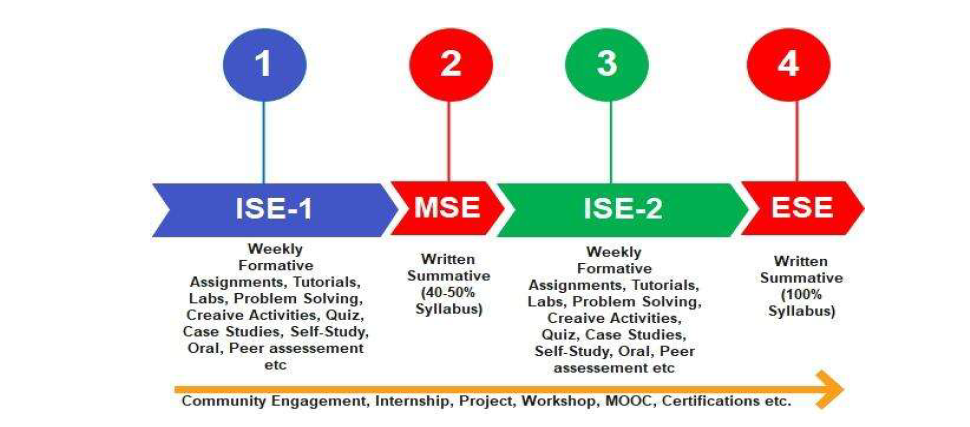
Following examinations are conducted in ODD as well as EVEN semester
1. ISE: In-Semester is continuous assessment of learning outcomes. It is sub-divided into two: ISE-1 and ISE-2.
2. MSE: Mid-Semester Examination to be conducted mid of the semester
3. ESE: End-Semester Examination to be conducted at the end of the semester
4. Special Examination: Special Examination with conditions apply
5. Re-Examination: Conducted for students failed in previous examinations
3.1 In Semester Evaluation (ISE):
ISE is the continuous assessment for a course and it shall be conducted exclusively by the course teacher, who shall spell out components of ISE in advance,
maintain transparency in its operation, declare evaluation results in time and show marks obtained to the students after the evaluation is completed. There are various modes recommended for conducting ISE like Open book examination, assignments, quiz, oral, group discussion, project, presentation, contests, model making etc.
SE assessments carried out before MSE are called as ISE-1 and ISE assessments carried out after MSE are called as ISE-2. Course teacher must submit ISE-1 marks mid of the semester to the examination center and ISE-2 assessment marks at the end of the semester. Typically, ISE-1 is for 20 marks and ISE-2 is for 20 marks, however it depends on the course. Teachers should prepare and follow relevant rubrics for the qualitative assessments of ISE.
3.2 Mid Semester Examination (MSE):
- MSE will be normally conducted in the mid of the semester. MSE question paper will be based on 40-50% of the syllabus and it will be conducted by the respective department. Department should conduct MSE according to the schedule published by the Examination Center of thecollege. Typically question paper will be of 30 Marks for 90 Minutes duration.
- Those students whose name is appeared in the defaulter list received from the department will not be allowed to attempt MSE.
3.3 End Semester Examination (ESE):
- ESE will be conducted at the end of the semester and it will be based on the entire contents of the syllabus. Typically question paper will be of 100 Marks for three hours duration (30% weightage). For few Laboratory based courses, practical or oral can be taken as an ESE based on the entire syllabus. ESE will also be conducted by the department according to the schedule published by the Examination Center of the college. The Examination Center shall get the examination schedule approved by the Examination Committee before displaying it.
- Those students whose name is appeared in the defaulter list received from the department will not be allowed to attempt ESE.
After the publication of the result of each ESE followed by Special Examination, the examinees will be provided with a cumulative grade card reflecting grades obtained and credits earned in each course along with SGPI in that semester and CGPI at end of every semester.
3.4 Special Examination:
➢ Students detained due to 50-75% attendance either in MSE or ESE are allowed to appear only in Special examination.
➢ The students who are unable to attempt due to medical reasons or those students who are declared as “failed” in the recently conducted ESE can attempt Special Examination. This examination is also allowed to those students who have passed in a course and wish to reappear in examination for the “Grade Improvement” purpose.
➢ All students who appear for special examination will have a grade penalty of one grade.
➢ Conducted after declaration of ESE result. The Odd Semester (I/III/V/VII) Special Examination shall be held in the first and second week of January and the Even Semester (II/IV/VI/VIII) examination in the first and second week of July. Students must fill the examination form to appear for Special exam and pay the requisite fees. Only those students who fill up the form within given time limit will be allowed to appear for special exam. This applies for Grade improvement applications as well. The notice for this will be circulated by exam section clearly mentioning the dates to fill up the form.
➢ Special Examination question paper will be for total 100 Marks three hours duration (60% weightage) based on entire syllabus. All students who attempt special examination will have on grade penalty.
3.5 Special Examination:
➢ Conducted for the students failed in ESE and/or Special examination. Students engaged in malpractice can appear only in the Re-examination. Students detained in any course with attendance less than 50% in the ongoing semester in either MSE or ESE are allowed to appear for first attempt only in Re-examination.
Detained students who have failed in first attempt in re-examination are allowed to appear for a subsequent attempt in re-examination.
➢ The Odd Semester (I/III/V/VII) Re-Examination shall be held in the first and second week of July and the Even Semester (II/IV/VI/VIII) Re-Examination in the first and second week of January.
➢ Reexamination question paper will be for Total 100 Marks THREE hours duration based on entire syllabus. All students who attempt re-examination will have one grade penalty and cap of B grade.
➢ Remedial lectures can be conducted for students having attendance between 50 to 75% and/or failed in End Semester Examination. These lectures shall be completed before start of Special/re-examination
Filling the examination form for Special and Re-examination is the responsibility of student. Due to any reason if student does not fill the form then he/she will lose that attempt and student can NOT claim an extra attempt in next exam.
The information related to course evaluation can be found in the following excerpt taken from the academic rule book.