Society of St. Francis Xavier, Pilar’s Fr. Conceicao Rodrigues College of Engineering
Society of St. Francis Xavier, Pilar’s

Some Content is Temporarily Unavailable Due to Ongoing Website Migration
Society of St. Francis Xavier, Pilar’s

Society of St. Francis Xavier, Pilar’s
Fr. Conceicao Rodrigues College of Engineering
An Autonomous Institute Affiliated to University of Mumbai | NAAC "A" Grade Accredited
Fr. Agnel Ashram, Bandstand, Bandra (W), Mumbai: 400050
Admissions Open 2025 |
NBA Accreditation Documents Updated |
Placement Drive Results Announced |
NAAC Peer Team Visit Scheduled |
Admissions Open 2025 |
NBA Accreditation Documents Updated |
Placement Drive Results Announced |
NAAC Peer Team Visit Scheduled
Fr. Conceicao Rodrigues College of Engineering
| An Autonomous Institute Affiliated to University of Mumbai | NAAC "A" Grade Accredited |

Electronics and Computer Science
Where hardware and software unite to engineer the future of smart technology.
About
The department was established in 1987 with B.E. in Electronics Engineering. From the academic year 2019-20, the course is renamed to Electronics and Computer Science to cope up with 4th Industrial revolution.
Fourth Industrial Revolution technologies such as Artificial Intelligence, Genome Editing, Augmented Reality, Robotics, Internet Of Things and 3-D printing are rapidly changing the way humans create, exchange and distribute resources. As in the case of previous revolutions, this will profoundly transform institutions, industries, and individuals. The Fourth Industrial Revolution can make exponential changes to the way we live, work and relate to one another due to the adoption of cyber-physical systems, Internet of Things and Internet of Systems. As we implement smart technologies in our factories and workplaces, connected machines will interact, visualize the entire production chain and make decisions autonomously. This revolution is expected to impact all disciplines, industries, and economies. Fourth Industrial Revolution could create a job market that's segregated into "low-skill/low-pay" and "high-skill/high-pay" segments. Over the years, strict adherence to quality norms in teaching-learning and evaluation has always been the strength of the department.
After a comprehensive study of the industry requirements as well as technological trends, the syllabus for the course Electronics and Computer Science has been framed to include courses that build a conceptual understanding of basics of Electronics as well as Computer Science. Additionally, advanced courses have been added to cover niche areas like Artificial intelligence and Machine Learning, Data Sciences, Mobile communication, VLSI, IoT, etc. A practical-oriented approach is being followed to make students proficient in the competitive industry environment as well as prepare them for higher education.
From HOD's Desk
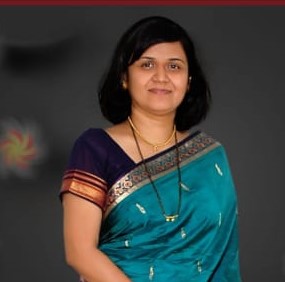
The Department of Electronics and Computer Science Engineering offers an academic programme which has an optimum mix of Electronics, Communication and Computer Engineering with an emphasis on VLSI, Embedded systems, Instrumentation, Automation and Robotics, and allied subjects. Our strict adherence to quality norms in teaching-learning and evaluation has always been the strength of the department. Students are moulded to be technically skilled and socially conscious so as to contribute to finding solutions to real-life problems. They are provided with avenues to develop inter-disciplinary projects and to acquire organization, presentation and leadership skills.
The department works with the commitment and resolves to keep the laboratories updated with the latest technologies, to adopt innovative teaching methodologies and thus to impart quality education in Electronics Engineering. We focus on Research in key areas such as Communication, Instrumentation, VLSI and Processor Architecture. The department has a good Industry interaction in terms of project design, consultancy, internships, and industry visits. Our Alumni occupy prestigious positions in reputed organizations in India and abroad.
Always striving to provide the best facilities to our students, the department is constantly on the move by organizing workshops, seminars, hands-on sessions to improve the practical aspects of a student’s learning process. An excellent academic ambiance with highly motivated faculty complemented with a wide variety of co-curricular and extra-curricular activities provide a holistic approach to the development of students.
Vision and Mission
Vision
Creating globally competent engineers with strong fundamentals and good learning ability to empower
Digitalization and Innovation.
Digitalization and Innovation.
Mission
- To enrich the competence in Electronics and Computer Science through knowledge, skills, and commitment to lifelong learning.
- To nurture effective solution providers having a practical knowledge base equipped with a multi-disciplinary approach.
- To cultivate an ambience to encourage innovation, research and entrepreneurship skills
- To improve employability by creating competitive engineers, with an ethical and professional attitude.
PEOs, POs and PSOs
Program Educational Objectives [PEOs]
Engineering Graduates will be able
- Graduates will have the ability to utilize their technical knowledge and professional skills for building successful careers while maintaining ethical standards.
- Graduates will have the ability to pursue higher studies and research activities in Electronics and Computer Science.
- Graduates will have the ability to become entrepreneurs and professionals in multi-disciplinary roles and take up leadership positions in global organizations.
Program Outcomes [POs]
Engineering Graduates will be able to
- Engineering knowledge: Apply the knowledge of mathematics, science, engineering fundamentals, and an engineering specialization to the solution of complex engineering problems.
- Problem analysis: Identify, formulate, review research literature, and analyze complex engineering problems reaching substantiated conclusions using first principles of mathematics, natural sciences, and engineering sciences.
- Design/Development of solutions: Design solutions for complex engineering problems and design system components or processes that meet the specified needs with appropriate consideration for public health and safety, and the cultural, societal, and environmental considerations.
- Conduct investigations of complex problems: Use research-based knowledge and research methods including design of experiments, analysis, and interpretation of data, and synthesis of the information to provide valid conclusions.
- Modern tool usage: Create, select, and apply appropriate techniques, resources, and modern engineering and IT tools including prediction and modeling of complex engineering activities with an understanding of the limitations.
- The engineer and society: Apply reasoning informed by the contextual knowledge to assess societal, health, safety, legal and cultural issues and the consequent responsibilities relevant to the professional engineering practice.
- Environment and sustainability: Understand the impact of the professional engineering solutions in societal and environmental contexts, and demonstrate the knowledge of, and the need for sustainable development.
- Ethics: Apply ethical principles and commit to professional ethics and responsibilities and norms of the engineering practice.
- Individual and teamwork: Function effectively as an individual, and as a member or leader in diverse teams, and in multidisciplinary settings.
- Communication: Communicate effectively on complex engineering activities with the engineering community and with society at large, such as being able to comprehend and write effective reports and design documentation, make effective presentations, and give and receive clear instructions.
- Project Management and finance: Demonstrate knowledge and understanding of the engineering and management principles and apply these to one’s work, as a member and leader in a team, to manage projects and in multidisciplinary environments.
- Life-long learning: Recognized the need for, and have the preparation and ability to engage in independent and life-long learning in the broadest context of technological change.
Program Specific Outcomes [PSOs]
Engineering Graduates will be able to
- Design and implement cost-effective hardware/software systems for real-life applications.
- Adapt to new generation technologies in Electronics & Computer Science domains with an innovative approach.
Faculty Members
Associate Professor and Head of Department
Dr. Swapnali Makade
Ph.D.(VLSI Design, VNIT, Nagpur)
Areas of interests:
VLSI, Nanotechnology, Computer Network, Software Engineering, Embedded System
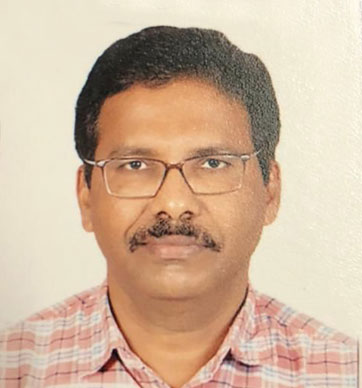
Professor & Dean Academics
Dr. Deepak Bhoir
Ph.D.
Areas of interests:
Instrumentation, Biomedical Instrumentation, Virtual Instrumentation, VLSI Design, MEMS, Automation
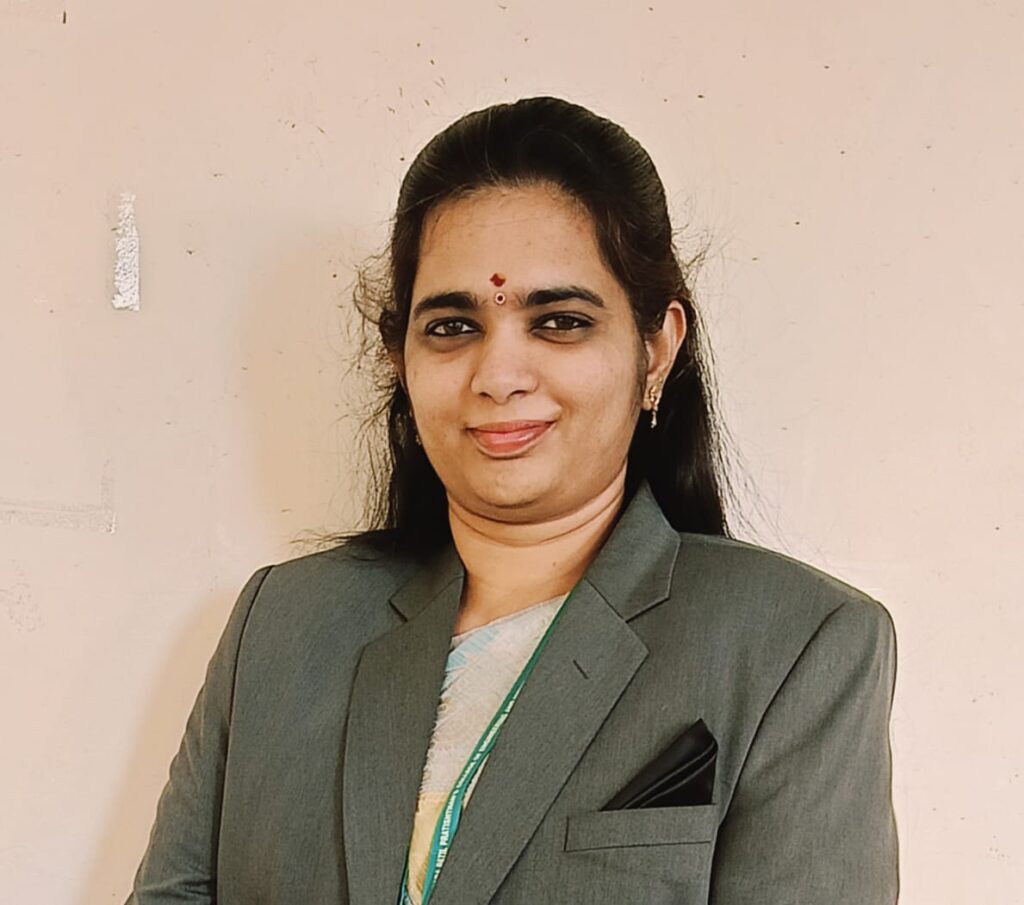
Associate Professor
Dr. K. Sailakshmi Parvathi
Ph.D. (Technology)
Areas of interests:
Meta material, Signals and System, Internet of Things. Ansys HFSS,Scilab, Python, Latex. Operating Systems
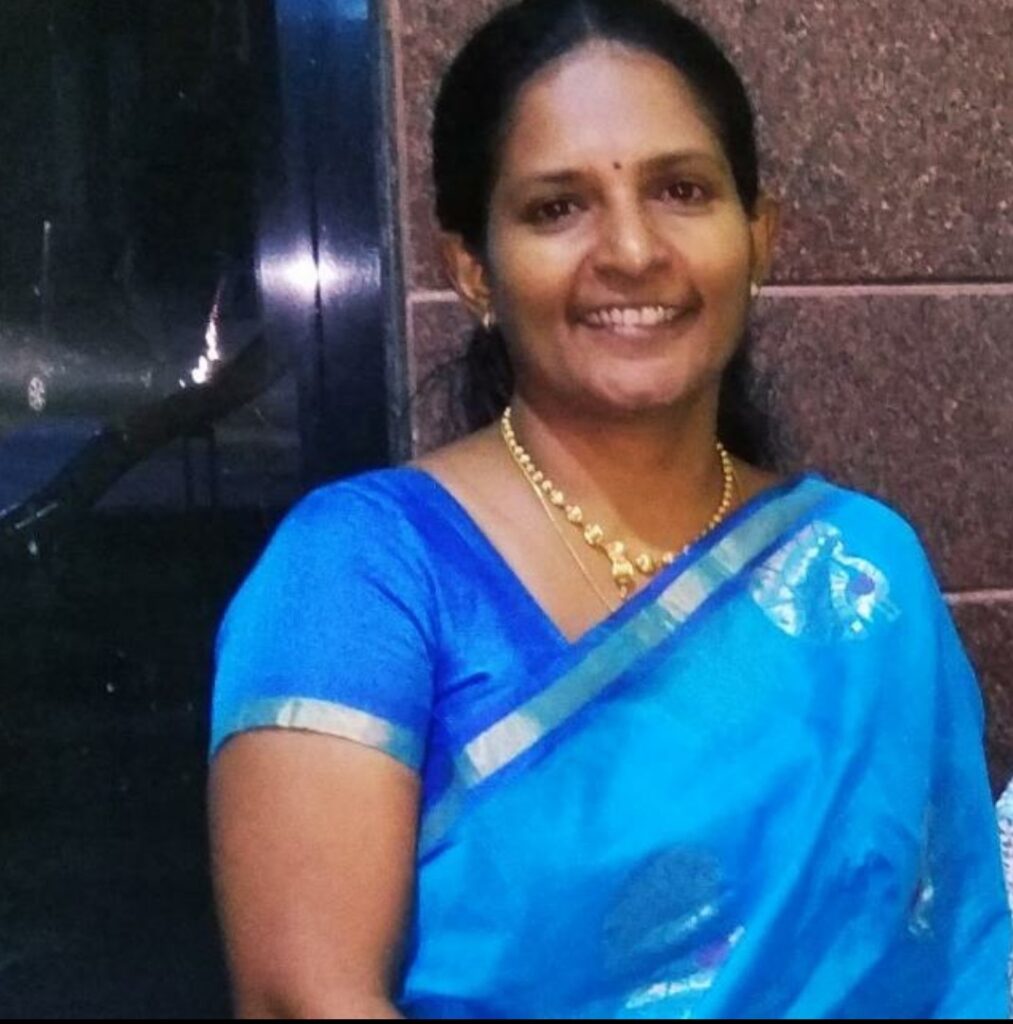
Assistant Professor
MS. Binsy Joseph
M.E., (Pursuing PhD)
Areas of interests:
Power electronics, Electrical Vehicle Battery Management, Renewable Energy System
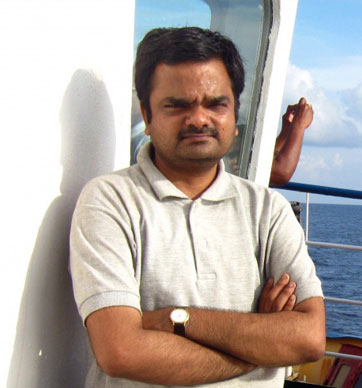
Assistant Professor
Mr. Vaibhav Godbole
Pursuing PhD (Electronics & Communication Engineering)
Areas of interests:
We Programming, Linux System Administration, Machine Learning, Bio-inspired Computation, Big Data Analytics
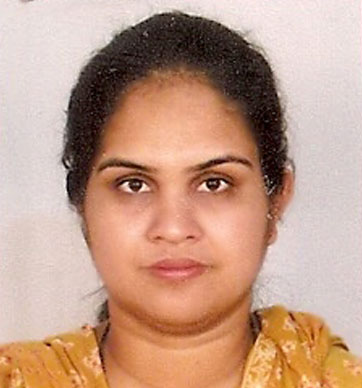
Assistant Professor
Ms. Archana Lopes
M.E., (Pursuing PhD)
Areas of interests:
Soft Computing, Computer Vision, Machine Learning, Data structures and algorithms, Discrete structures, Automata theory, Object oriented programming
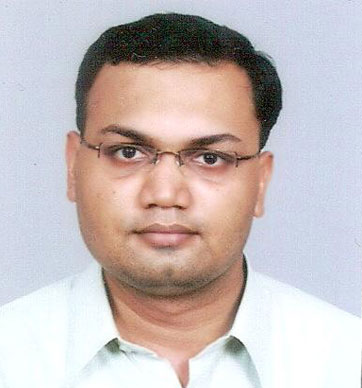
Assistant Professor
Mr. Jayen Modi
M.E., (Pursuing PhD)
Areas of interests:
Electronic Devices & Circuits, Signal Conditioning Circuit Design, Control Systems Engineering, Instrumentation Systems, Industrial Automation & Process Control, Management Information Systems, Project Management
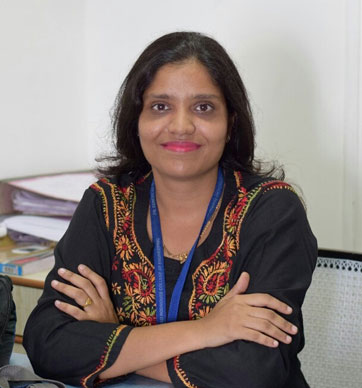
Assistant Professor
Ms. Prajakta Bhangale
M.E., (Pursuing PhD (Technology – Computer Engineering))
Areas of interests:
Security, Block Chain Technology, Big data Analysis, Java Programming
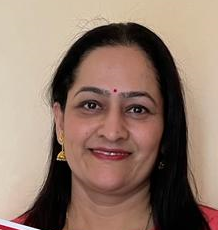
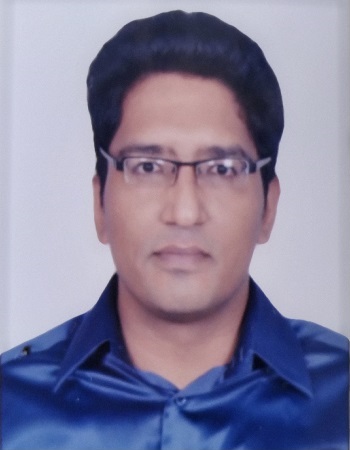
Assistant Professor
DR. Inderkumar Kochar
Ph.D.
Areas of interests:
Polarimetric SAR Imaging, Microwave Engineering, Digital Signal Processing, Communication Systems
Supporting Staff
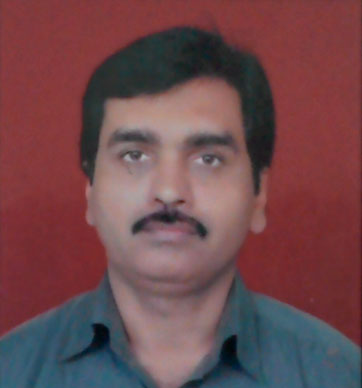
Laboratory Assistant
Ms. Pradnya Nandaskar
(Computing Laboratory – 1 and Hardware Laboratory – 2)
Laboratory Assistant
Ms. Shalaka Parab
(Computing Laboratory – 2 and Hardware Laboratory – 1)
Infrastructure
Facilities
The Department is headed by Dr. Sapna Prabhu who holds a Ph.D. degree (Technology) with her area of Research being Computer Architecture. She has over 26 years of teaching experience and numerous publications in International Conferences and Journals.
The present faculty strength of the department is 10 which include 2 Professors, 1 Associate Professor, and 7 Assistant Professors. These include 2 Doctorate and 8 Post- Graduates. 6 faculty members are pursuing their doctoral degrees. All Laboratory Technicians and Laboratory Assistants are qualified and skilled. The staff members are always encouraged to upgrade their academic qualifications and contribute to research publications. The Department boasts of committed faculty members with rich teaching and industrial experience who have been with the Department for several years and this has helped in the development of a well-knit team. To keep abreast of the latest developments, the Department organizes technical programs and sponsors faculty for courses in their areas of interest and qualification improvement.
Students with good MHT-CET/AIEEE/JEE scores get admitted to the Department. The students maintain a good academic record and regularly organize and participate in various co-curricular and extracurricular activities, both within the college and at the intercollegiate level. Most of them get placed in reputed companies or pursue higher studies.
The Department has an adequate number of well-equipped and well-maintained laboratories which are regularly updated and new laboratories are developed as the need arises.
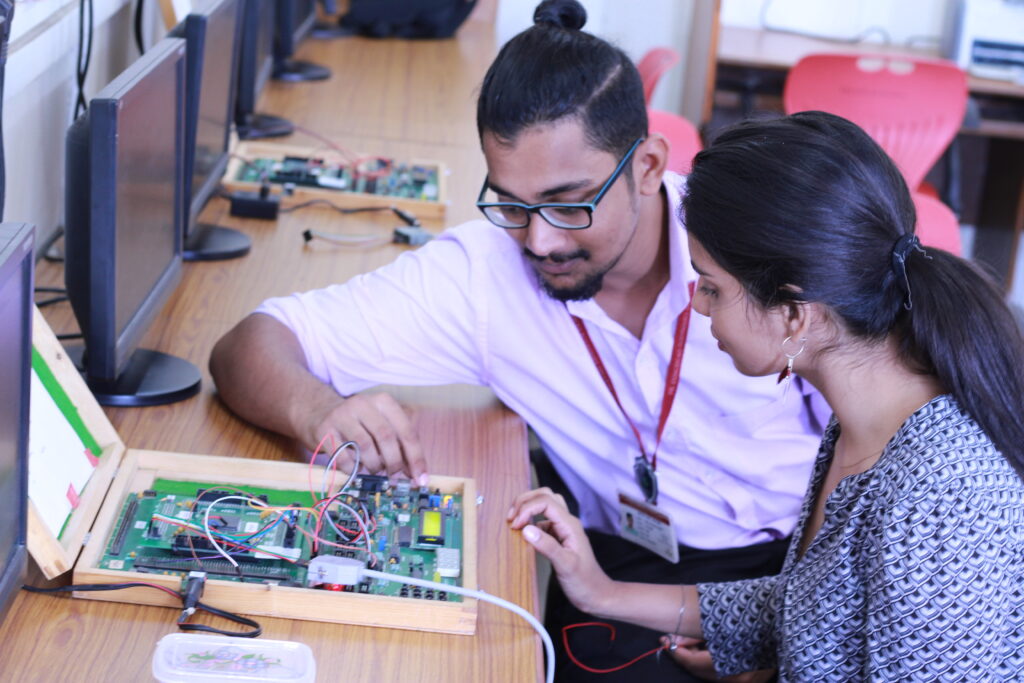
Computing Laboratory - I
This laboratory caters to the subjects Web Technologies, Software Engineering, Embedded Systems, Computer Organization and IOT.
The laboratory is equipped with 21 desktop computers with various embedded system software and kits. Also, a Remotelab facility is created to enable the students to access the FPGA and ARM kits remotely. Various software available are: Proteus, Keil, Mplab, TASM, S51, AVR studio, Winpic, RTOS, PSoC Creator Software, Star UML
Various available kits are: 8085, 8086, 8051 kits, ARM kits, ARM-Cortex, AVR kits, Universal trainer kit (ARM+PIC), PSoC Kits, Stepper motor controller cards.
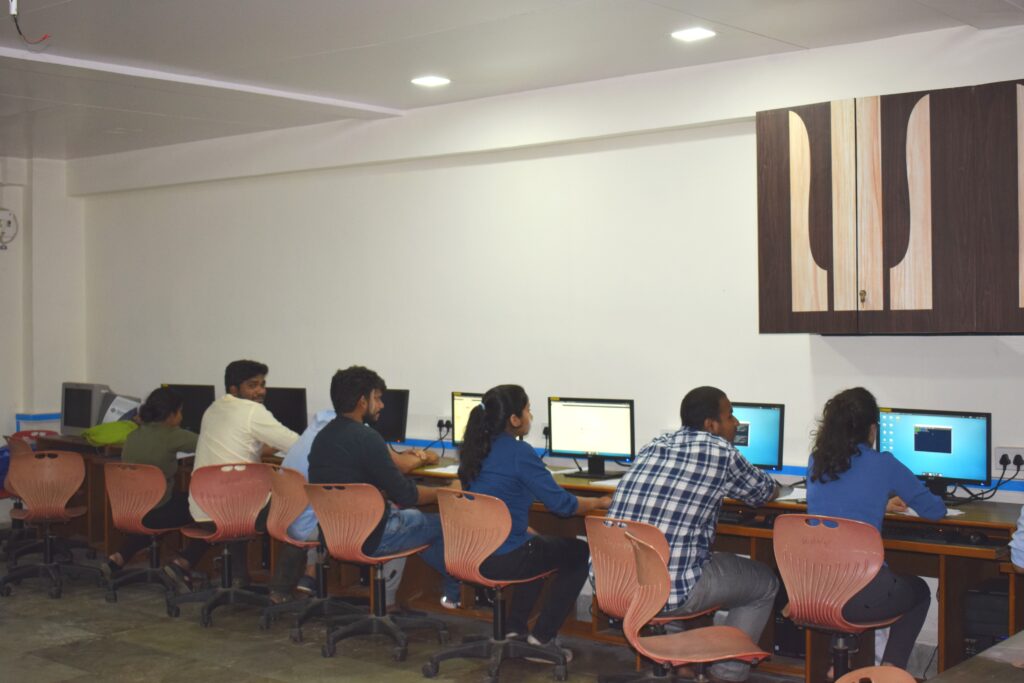
Computing Laboratory - II
The laboratory caters to the subjects like VLSI Design, Image Processing. Simulation experiments of Digital and Analog circuits are also conducted in this laboratory.
It is equipped with Sun Solaris Workstations and additional machines on dual operating VHDL software to simulate and synthesize any digital circuit.
Students can get hands-on experience on SILVACO (the back-end software for process simulation), MAGIC (layout design software), LabView for process simulation and SPICE for circuit simulation.
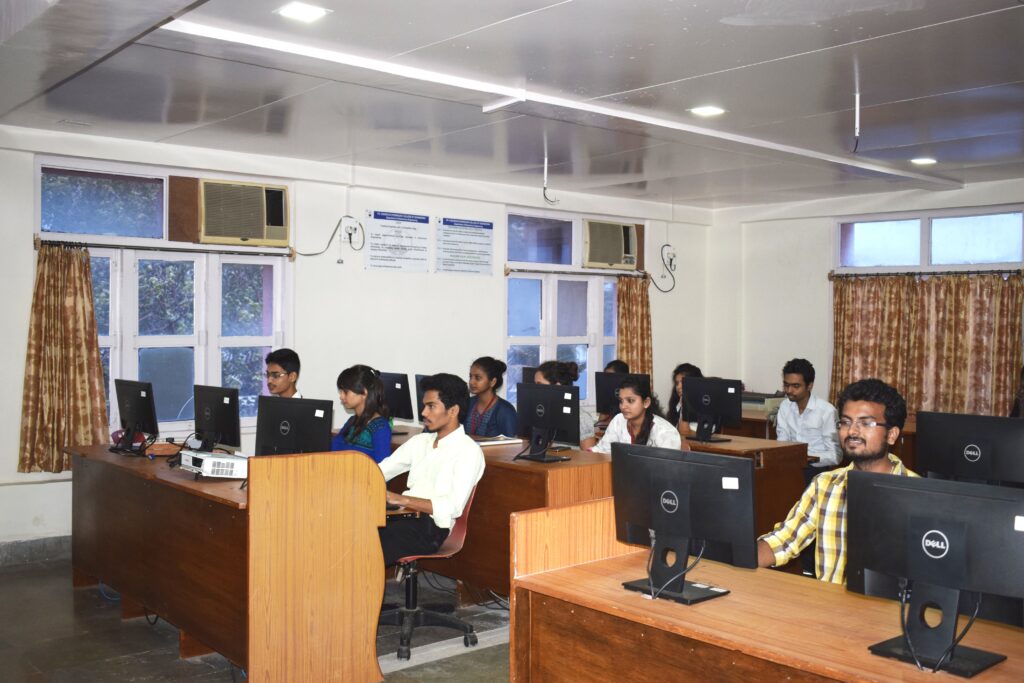
Computing Laboratory - III
This laboratory caters to various courses such as Filter Theory and Applications, Wireless Communication, Continuous Time Signals and Systems, Discrete Time Signal Processing, Data Communication Networks, Advanced Communication Theory and Computer Networks.
It is equipped with 20 Sun-Ray workstations, Matlab software with communication and Signal processing toolboxes which help to simulate and model Communication and Computer Networks . An Antenna trainer and a TV trainer are used for Communication System practicals. Spectrum Analyzer and Digital Signal Processing kits with the DSP processor TMS320C6713 are used for various signal processing applications.
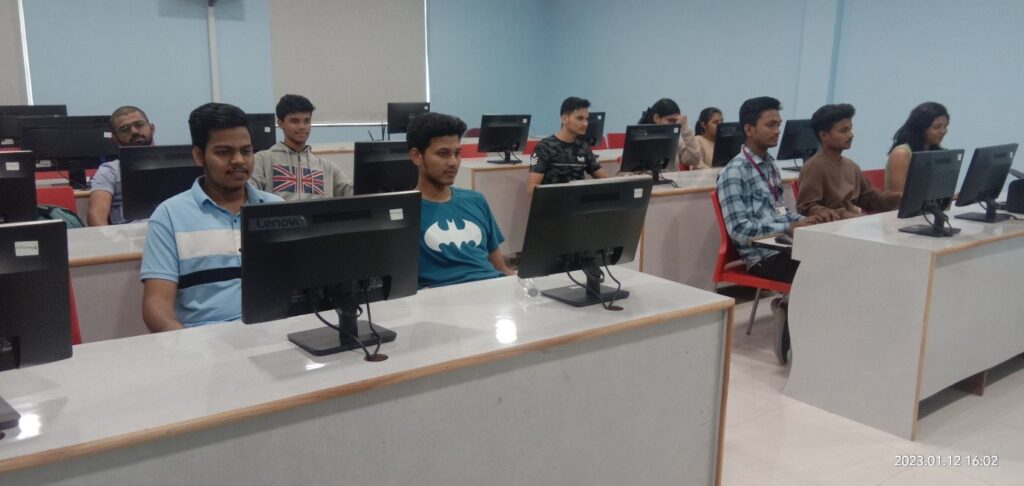
Computing Laboratory - IV
This laboratory caters to the advanced computer courses like Artificial Intelligence, Machine Learning, Deep Learning, Natural Language Processing, and Big Data Analytics. It facilitates students to develop advanced intelligent applications by combining computational algorithms and statistical models. The lab is equipped with 20 high-end machines with advanced open source software such as Anaconda, Jupyter, Weka, Hadoop, MongoDB installed.
Hardware Laboratory - I
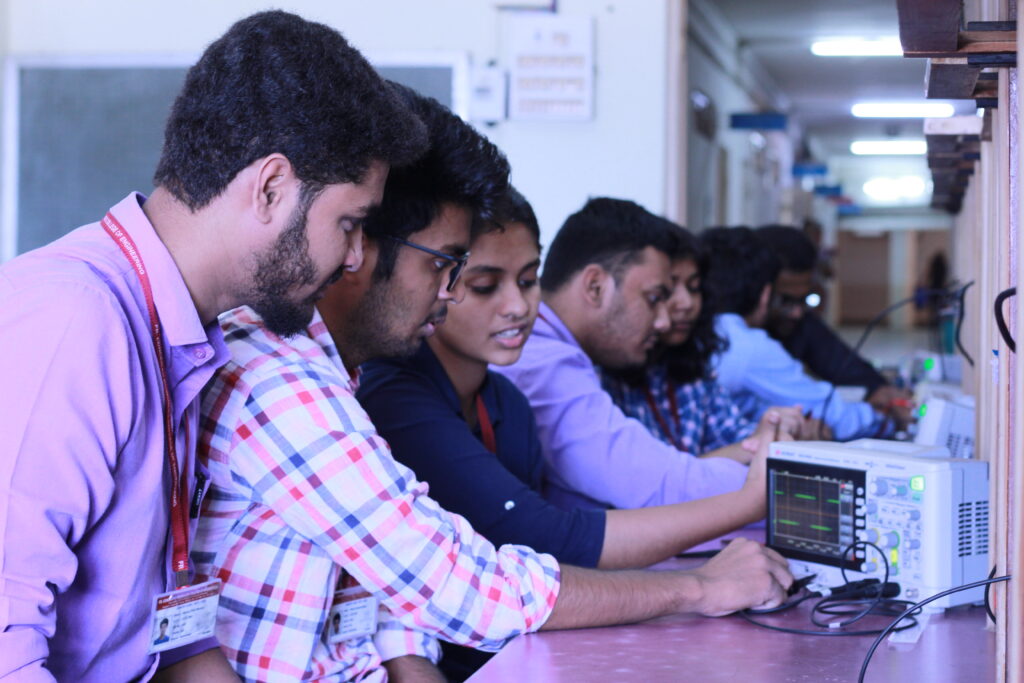
The Laboratory is being utilized for practical courses in Electronic Devices and Circuits, Power Electronics. It is equipped with various Power Electronics kits such as Choppers, Inverter, D.C. drives, A.C. drives, UPS.
Hardware Laboratory - II
This laboratory is used for practical courses in Instrumentation Systems, Control System, Robotics and Mechatronics. It has PID controller and PLC kits for experiments in Process Instrumentation, Servo motors, Synchros, etc for conducting experiments in Control Systems.
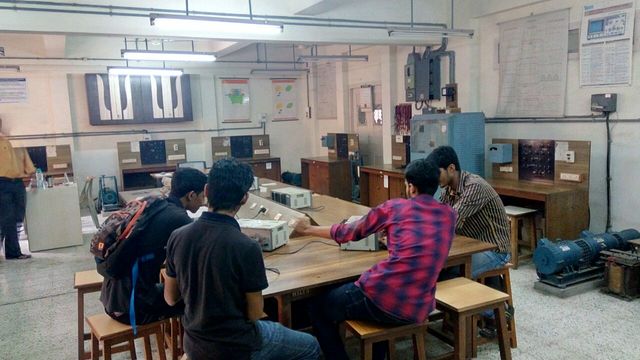
Electrical Lab
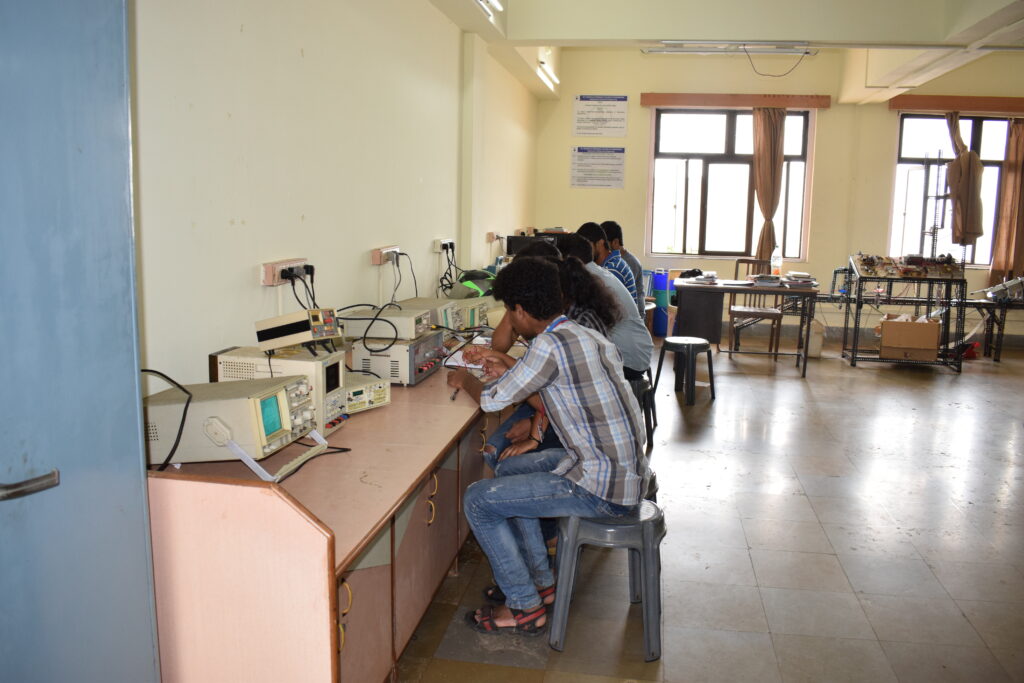
Electrical Engineering Laboratory is mainly utilized for Laboratory courses in Basic Electrical Engineering (FEC105) for First year, Industrial Electronics (MEL 401) and Electrical Wiring Workshop. This laboratory is developed to conduct experiments on Electrical Machines, Transformers and other Electrical experiments. This laboratory is equipped with Electrical machines like 3phase Induction motor, DC motors, Synchronous motor, Motor-Generator set, alternator and Transformers. Lab is equipped with Digital storage Oscilloscope, Multi-Meters , 3 phase Rectifier Unit, Function Generator, DC power supply, Digital Tachometer etc. Also many trainer kit like LVDT trainer kit, RTD kit, electronic measuring instruments are available in the laboratory.
Innovative Teaching and Learning Practices
Innovative teaching and learning practices play a crucial role in modern education by transforming traditional classroom dynamics and creating a more engaging, student-centered environment. Techniques like flipped classrooms, project-based learning, gamification, and the use of digital tools encourage active participation, collaboration, and hands-on experiences. These approaches not only make learning more enjoyable but also promote critical thinking, problem-solving, and creativity. By moving beyond passive memorization, innovative methods help students connect theoretical knowledge to real-world applications, enhancing long-term retention and understanding. Additionally, they cater to diverse learning styles, fostering inclusivity and making education more accessible to all students. In a rapidly evolving world, such practices are essential for preparing learners to adapt to new challenges, develop lifelong learning skills, and succeed in both their personal and professional lives.
Some of the sample snapshots of the activities are mentioned below:
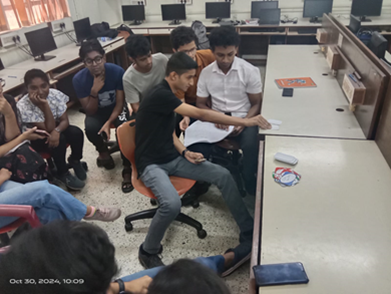
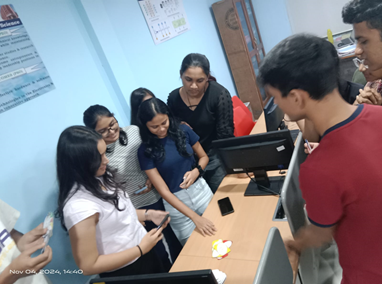
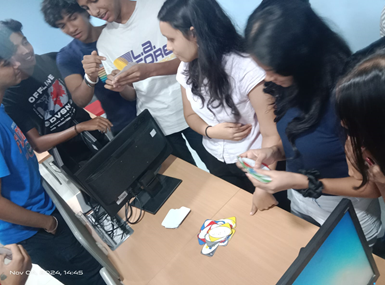
UNO CARD GAME FOR DIGITAL ELECTRONICS
The Uno card game for teaching combinational circuits has proven to be an engaging and impactful tool, as students enjoyed the experience and even requested more time to play. This response highlights the effectiveness of gamification in education, especially in technical subjects like digital electronics. By integrating game elements, students are motivated to explore and learn complex concepts in a relaxed and enjoyable setting, which enhances retention and deepens their understanding.During gameplay, students varied the combinations of input and output to match the card requirements, actively applying their knowledge of circuit principles. This hands-on approach not only reinforces their understanding of logic functions but also encourages creativity in problem-solving. Importantly, the game creates a fail-free environment where students can experiment without the fear of making mistakes. This supportive atmosphere fosters collaboration, competition, and critical thinking, allowing them to engage with the material confidently. As students seek more time with such activities, it is evident that gamification can cultivate a passion for learning, improve comprehension, and build confidence in applying theoretical knowledge to practical problems.
Virtual Labs:
Object Oriented Programming Methodology:
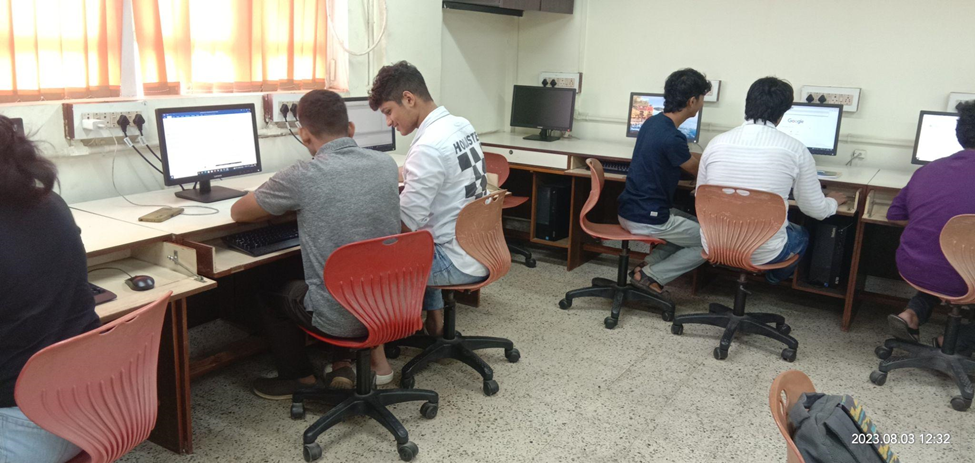
In the Java OOPM Virtual Lab, students designed and implemented object-oriented programs using key concepts like classes, objects, inheritance, encapsulation, and polymorphism. Through interactive simulations and coding exercises, they developed real-time applications and enhanced their problem-solving skills in a virtual environment.
Link to the virtual lab – https://virtuallabjava.netlify.app
Debate Activity
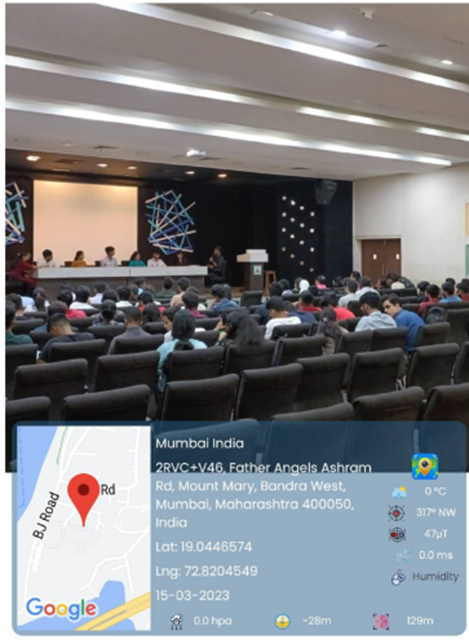
(16 MARCH 2023)
Artificial Intelligence - Semester VI
Machine Learning- Semester VI
Natural Language Processing- Semester VIII
The debate is aimed and designed to provide a better understanding and generate interest in the subject. Students from the third year and final year participated in the debate. There were 12 groups for the debate, six from each class. Each group had 4 debating members. Each group needs to come prepared with enough sources of information to debate for 10 min. Dr. Sapna Prabhu, Head of the Department of Electronics and Computer Science was the judge for this debate. The Proponent team for the topic “ Will language AI replace human translators” won the debate. Jason Rodrigues from TE ECS is awarded best debater.
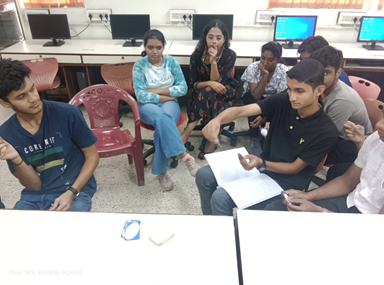
Think-Pair-Share is a collaborative learning strategy that fosters critical thinking and effective communication among students. It can be applied in a DBMS classroom to encourage participation and engagement in understanding database concepts.
- Think: Students are given a specific question or problem related to DBMS, such as designing a relational schema, writing SQL queries, or normalizing a database. They are asked to think individually about the solution for a few minutes, allowing them to organize their thoughts.
- Pair: Students pair up with a partner to discuss their individual solutions. For example, they might compare different normalization approaches or discuss the structure of their SQL query. This step allows them to refine their ideas and learn from their peer’s perspective.
- Share: Pairs share their conclusions with the larger group or class. This can include presenting their schema, explaining the reasoning behind their query, or demonstrating how they achieved normalization. The instructor facilitates discussion, ensuring that different approaches are analyzed and misconceptions are clarified.
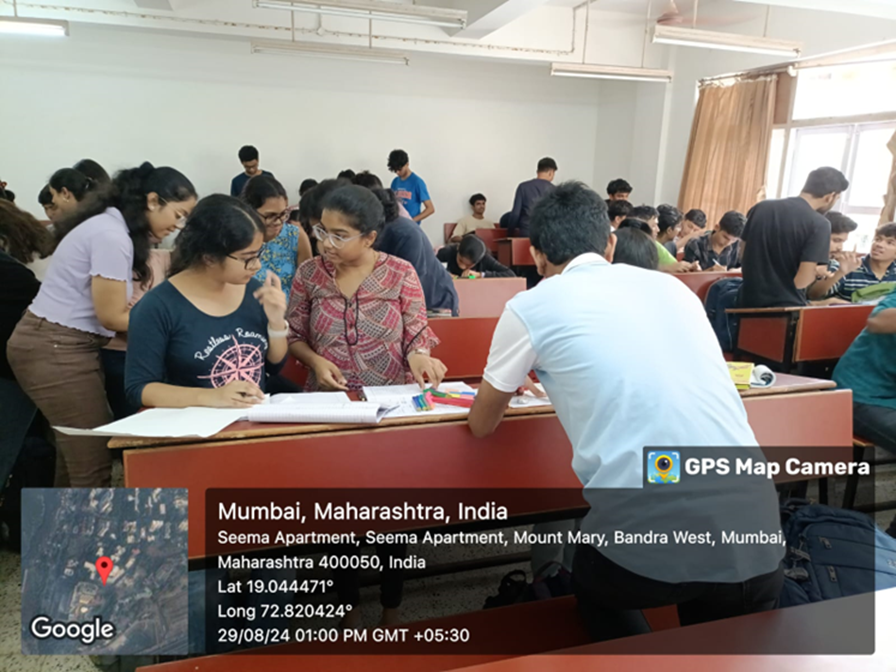
Database Design Contest
A Database Design Contest is an engaging and competitive classroom activity aimed at enhancing students’ understanding of database concepts, design principles, and problem-solving skills. This activity promotes creativity, teamwork, and application of theoretical knowledge to real-world problems.
Innovating Teaching Learning Pedagogy (2023-24)
| Sr No | Name of Faculty | Subject Name | Sem | Activity |
|---|---|---|---|---|
| 1 | Dr Sapna Prabhu | Computer Organization and Architecture | V | Debate Activity on 'CISC vs RISC design', Class discussion on 'Moore's Law' |
| 2 | Dr Sapna Prabhu | Embedded systems and RTOS | VI | Class discussion on Communication Buses |
| 3 | Prof. Vaibhav Godbole | Linux Server Administration Lab | VIII | Experiment based learning on open source licenses |
| 4 | Prof. Vaibhav Godbole | Data warehousing and mining | VIII | Quiz, YouTube videos without sound, Flipped classroom |
| 5 | Prof. Dipali Koshti | Natural language Processing | VIII | IIT virtual labs, Debate, Technical papers, NPTEL videos, Case study |
| 6 | Prof. Dipali Koshti / Ms. Prajakta Bhangale | Big data analytics / Game Learning | VII | Game based learning (Football game) |
| 7 | Prof. Vaibhav Godbole | Software engineering and web technologies | VII | Learning through projects |
| 8 | Ms. Archana Lopes | Skill Based Lab - Python Programming | II | NPTEL Assignments in Python |
| 9 | Ms. Archana Lopes | Machine Learning | Debate Activity, Paper presentation activity | |
| 10 | Prof. Prajakta Bhangale | Blockchain technologies | VII | Technical Paper presentation on Geospatial blockchain |
| 11 | Prof. Prajakta Bhangale | Big data analytics | VII | Mind Map Activity |
| 12 | Prof. Prajakta Bhangale | System security | VIII | Project Proposal on Geospatial data, Tool exploration for security audit |
Innovating Teaching Learning Pedagogy (2022-23)
| Sr No | Name of Faculty | Subject Name | Sem | Activity |
|---|---|---|---|---|
| 1 | Dr Sapna Prabhu | Internet of Things | VII | Technical paper analysis session on Database management in IoT |
| 2 | Dr Sapna Prabhu | Computer Organization and Architecture | V | Debate Activity on 'CISC vs RISC design' |
| 3 | Dr Sapna Prabhu | Computer Organization and Architecture | V | Class discussion on 'Moore's Law' |
| 4 | Dr Sapna Prabhu | Embedded systems and RTOS | VI | Class discussion on Communication Buses |
| 5 | Prof. Dipali Koshti | Natural Language Processing | VIII | IIT virtual labs, Debate, Technical paper study, NPTEL videos, Case study |
| 6 | Prof. Dipali Koshti | Database Management System | III | Think-Pair-Share (TPS) |
| 7 | Prof. Vaibhav Godbole | Software Engineering | V | Learning through Projects |
| 8 | Prof. Vaibhav Godbole | Web Technologies | V | Hands-on sessions (HTML/CSS/PHP/JQuery/JavaScript) |
| 9 | Ms. Prajakta Bhangale, Ms. Archana Lopes, Ms. Dipali Koshti | AI/ML/NLP | VI | Debate Activity |
| 10 | Prof. Prajakta Bhangale | AI | VI | Debate, NPTEL videos, Case study |
Placement, Higher Studies and Internship
Placement Statistics
Placements
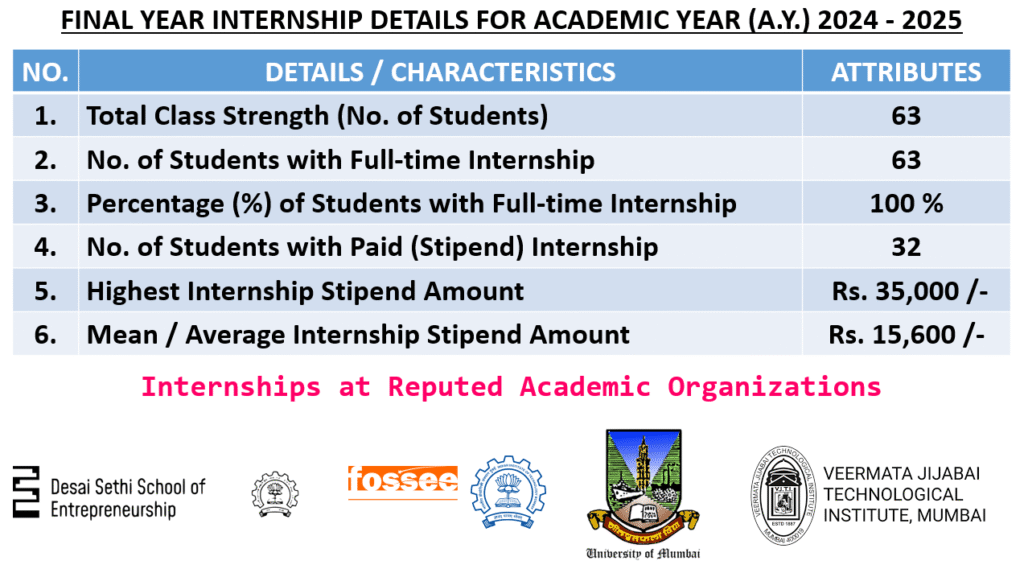
Placement Statistics of outgoing students (2024-25)
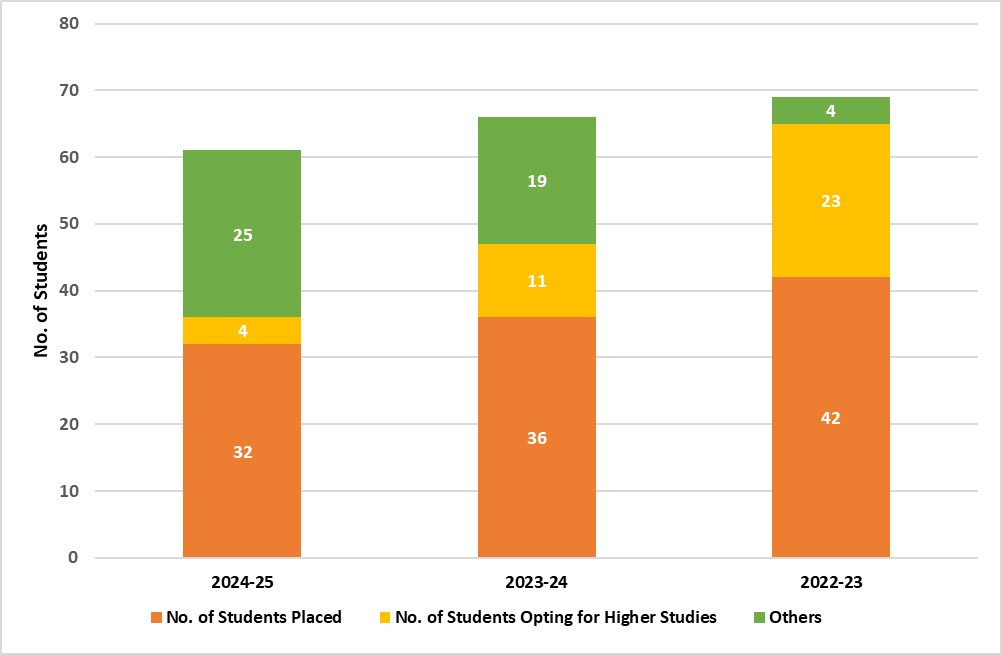
Placement Summary for the last 3 years
| No. | Students’ Classification Details | Total Count / Number | Remarks / Comments |
|---|---|---|---|
| 1 | No. of Students on Roll (Batch Strength of Entire Class) | 68 | Actual Number of Students on roll |
| 2 | No. of Students Not Eligible (Insufficient CGPA / Drop / Live KT) | 10 | Eligibility as per Company Policy |
| 3 | No. of Students Opting for Higher Studies in India or Abroad | 15 | Student & Parent Decision / Consent |
| 4 | No. of Students Opting for Other Career Choices / Options | 1 | Student & Parent Decision / Consent |
| 5 | No. of Students for Entrepreneurship / Family Business | 2 | Student & Parent Decision / Consent |
| 6 | No. of Total Eligible & Interested Students for Placements | 40 | Opting for On-campus Placement |
| No. | Overall Details of Placed Students | Total Count / Number | Remarks / Comments |
| 1 | No. of Offers for all Placed Students in the Department | 41 | Offer to Student Ratio = 1.13 |
| 2 | No. of Students with Single / One (01) Offer | 30 | 30 Students Secured 1 Job Offer |
| 3 | No. of Students with Double / Two (02) Offers | 6 | 06 Students Secured 2 Job Offers |
| 4 | No. of Students with Triple / Three (03) & Above Offers | ----- | ----- |
| 5 | No. of Students Placed Overall in Department | 36 | 36 Students Placed Overall |
| 6 | Placement Percentage (%) for Academic Year 2023 – 2024 | 90.00 % | ----- |
| No. | Package / Cost to Company (CTC) / Salary Details per Annum | Indian Rupees (INR) | Remarks / Comments |
| 1 | Highest Salary Package / Cost to Company (CTC) Offered | 14,08,342 /- | NBA (India) Basketball Pvt. Ltd. |
| 2 | Lowest Salary Package / Cost to Company (CTC) Offered | 1,20,000 /- | On My Own Technology (OMO) |
| 3 | Average Salary Package / Cost to Company (CTC) | 7,64,000 /- | ----- |
| 4 | Median Salary Package / Cost to Company (CTC) | 4,35,000 /- | ----- |
ACADEMIC YEAR 2023 – 2024
Placement Statistics
List of Students
Video Testimonials
Vrushank Arur (Batch 0f 2025)
Ruchita Rao (Batch 0f 2025)
Yash Thorat (Batch 0f 2024)
Yukta Wagh (Batch 0f 2024)
Andrea Pinto (Batch 0f 2023)
Arpita Kar (Batch 0f 2023)
Atharva Joshi (Batch 0f 2023)
Pinto Emmanuel (Batch 0f 2023)
Sherwin Dsouza (Batch 0f 2023)
Research
Publications and Patents
| Sr. | Patents Published |
|---|---|
| 1 | Prof Surendra Rathod and Dhananjay Kalbande published a patent with Application Ref No 202321008008, filing Date - 08/02/2023- Indian Patent Office, AI POWERED SINGLE SWITCH BASED REMOTE HEALTH MONITORING SYSTEM FOR ELDERLY. |
| 2 | Prof Surendra Rathod and Prof Dave Jenil published a patent with Application Ref No 202221002564 , filing Date - 17/01/2022 - Indian Patent Office, INTELLIGENT CONTROL SYSTEM TO DELIVER WATER FOR BATHING. |
| 3 | Prof Surendra Rathod, Haldankar Govind, Bhat Bhardwaj, Bath Tejveer Singh, Dhar Gopala, Bhattacharjee Soumyadeb, Mainkar Yash, Gokhale Rutuja published a patent with Application Ref No 202021010812, filing Date - 13/03/2020- Indian Patent Office, ELECTROMECHANICAL SYSTEM FOR SEGREGATION AND RECOVERY OF PLASTIC FROM SAND BEACH. |
| 4 | Prof. Vaibhav Godbole published a patent with Application Ref Number 392016-001, Filing Date-15/03/2024- Indian Patent Office, BLOCKCHAIN ENABLED SURVILLANCE DEVICE |
| 5 | Prof. Archana Lopes and team published a patent with Application Ref Number 202321015188, Filing Date -31/03/2023 -Indian Patent Office, VERBAL AGREEMENT SIGNING USING BLOCKCHAIN AND SPEECH RECOGNITION. |
| 6 | Prof. Archana Lopes and team published a patent with Application Ref Number 202321018653, Filing Date -14/04/2023-Indian Patent Office Meta Store -AN IMAGE BASSED 3D GARMENT MAKING SYSTEM FOR VIRTUAL TRY ONS. |
| 7 | Prof. Dipali Koshti and team published a patent with Application Ref Number 202321027909, Filing Date 19/05/2023 -EDUVQA-A MULTIMODAL MULTI KNOWLEDGE OPEN DOMAIN VISUAL QUESTION ANSWERING MODEL FOR EDUCATION. |
| Copyright | ||||||
|---|---|---|---|---|---|---|
| Sr. No | Name of the faculty | Copyright Number | Title | Type | Date published | Status |
| 10 | Prof. Prajakta Bhangale | SW-19726/2024 | Copyright on “Geospatial Data Security by using Hybrid Chaotic Map” | Indian | 22/11/2024 | Registered |
| Year 2024-25 | |
|---|---|
| 1 | Sushma Nagdeote and Sapna Prabhu, "Enhanced U-Net Framework for Nuclei Segmentation in Triple Negative Breast Cance"; 2024 Second International Conference on Intelligent Cyber Physical Systems and Internet of Things (ICoICI), Coimbatore, India, 2024, pp. 1321-1326, doi: 10.1109/ICoICI62503.2024.10696356 |
| 2 | T. Kumbhar, D. Agrawal, L. Saldanha and D. Koshti, "AI-Driven Credit Scoring and Credit Line Solution for the Unreserved and Self-Employed", 2024 Second International Conference on Inventive Computing and Informatics (ICICI), Bangalore, India, 2024, pp. 178-184, doi: 10.1109/ICICI62254.2024.00039 |
| 3 | Dipali Koshti, Ashutosh Gupta, Alok Kumar, and Arvind Sharma ,"Knowledge Incorporated Image Question Answering using Wikidata Repository", Fourth International Conference on Innovations in Computational Intelligence and Computer Vision, ICICV-2024 (springer), April 2024. |
| 4 | V. Godbole and S. Gaikwad, “An Exponential Map-based Whale Optimization Algorithm (Exp-WOA) for Optimization”, ECTI-CIT Transactions, vol. 18, no. 4, pp. 443–455, Sep. 2024. |
| 5 | An Extensive Review : Models for Reginoal Language Speech Recognition |
| 6 | "Apps For E-Commerce Using Blockchain Web 3.0", 3rd International Conference on Advanced Communication and Intelligent Systems (ICACIS-2024) May 16-17 2024 (presented) |
| 7 | "Exploring Computational Approaches for Crime Prediction and Analysis: A Comprehensive Study", 3rd International Conference on Advanced Communication and Intelligent Systems (ICACIS-2024) May 16-17 2024 (presented) |
| 8 | Enhanced Geospatial Raster Data Protection: Harnessing Chaos Maps and DNA Encryption,8th International Conference on Computing, Communication, Control and Automation (ICCUBEA-2024) (Presented) |
| 9 | Navigating the Intersections of Quantum Computing, DNA-Based Data Storage, and Geospatial Data Security: An Overview, 8th International Conference on Computing, Communication, Control and Automation (ICCUBEA-2024) (Presented) |
| 10 | J. Rambhia and R. Sutar, "Cogni-Sonance: Navigating the Neurological Orchestra of Imagined Speech", 2024 International Conference on Artificial Intelligence and Emerging Technologies, Noida, India, 2024. |
| Year 2022-2023 | |
|---|---|
| 1 | D. Koshti, A. Gupta and M. Kalla, "Knowledge Blended Open Domain Visual Question Answering using Transformer," 2023 Third IEEE International Conference on Artificial Intelligence and Smart Energy (ICAIS), Coimbatore, India, 2023, pp. 823-828, doi: 10.1109/ICAIS56108.2023.10073911. |
| 2 | M. Dias, H. Aloj, N. Ninan, D. Koshti and S. Kamoji, "First Aid and Emergency Assistance Robot for Individuals at Home using IoT and Deep Learning," 2023 7th International Conference on Computing Methodologies and Communication (ICCMC), Erode, India, 2023, pp. 1261-1269, doi: 10.1109/ICCMC56507.2023.10083934. |
| 3 | D. Koshti, Ashutosh Gupta, and M. Kalla, “BERT based Hierarchical Alternating Co-Attention Visual Question Answering using Bottom-Up Features”, Int J Intell Syst Appl Eng, vol. 10, no. 3s, pp. 158–168, Dec. 2022. |
| 4 | Archana Lopes, Sangeeta P, Trupti S. “A Chatbot as first responder for panic attack”.Gradiva Review Journal, ISSN : 0363-8057, Page No. 253-258. DOI: 10.37897.GRJ.2022.V818.22.50429 |
| 5 | Chaudhari, Yashaswini Sunil, Vanessa William Dmello, Srushti Suraj Shah, and Prajakta Bhangale. "Autonomous Timetable System Using Genetic Algorithm." In 2022 4th International Conference on Smart Systems and Inventive Technology (ICSSIT), pp. 1687-1694. IEEE, 2022. |
| 6 | Shetty, Monali, Prajakta Bhangale, Samarth Mehta, Sumit Kothari, and Sharvari Tamane. "Review Helpfulness Prediction using Deep Learning." Computer Integrated Manufacturing Systems 28, no. 11 (2022): 673-685. |
| 7 | Bhangale, Prajakta, and Shubhangi Vaikole. "Study on Approaches for Geospatial Data Security." JOURNAL OF ALGEBRAIC STATISTICS 13, no. 2 (2022): 1165-1169. |
| 8 | Kasambe, P.V., Bhole, K.S., Raykar, N.R., Oza, A.D., Ramesh, R. and Bhoir, D.V., 2022. Mechanical modeling, numerical investigation and design of cantilever beam for low pull-in MEMS switch. International Journal on Interactive Design and Manufacturing (IJIDeM), pp.1-10. |
| 9 | Kasambe, P. V., Kiran S. Bhole, A. A. Bage, N. R. Raykar, and D. V. Bhoir. "Analytical modeling and numerical investigation of a variable width piezoresistive multilayer polymer micro-cantilever air flow sensor." Advances in Materials and Processing Technologies (2022): 1-19. |
| Year 2023-2024 | |
|---|---|
| 1 | R. Joglekar, R. Daniels, A. Jagare, P. Shah and S. S. Rathod, "TIQ Comparator Based 8-bit Flash ADC for Communication Applications", 2022 Sardar Patel International Conference on Industry 4.0 - Nascent Technologies and Sustainability for 'Make in India Initiative, Mumbai, India, 2022, pp. 1-6, doi: 10.1109/SPICON56577.2022.10180784. |
| 2 | Shah, P., Sawant, S., Randive, R., Singh Manhas, S., S. Singh Rathod, S. (2023). "Implementation of Retinal Pathways". International Journal of Microsystems and IoT, 1(7), 445–451. https://doi.org/10.5281/zenodo.10441440 |
| 3 | M. R. Bansode and S. S. Rathod, "Enhanced Signal and Power Integrity using Novel Planar EBG design", 2023 Joint Asia-Pacific International Symposium on Electromagnetic Compatibility and International Conference on ElectroMagnetic Interference", Compatibility (APEMC/INCEMIC), Bengaluru, India, 2023, pp. 1-4, doi: 10.1109/APEMC57782.2023.10217404. |
| 4 | Shah, Payal, Reena Sonkusare, and Surendra S. Rathod. "FinFET based photoreceptor for silicon retina to reduce power consumption." Biosensors and Bioelectronics: X 14 (2023): 100330. |
| 5 | Manisha R. Bansode, Surendra S. Rathod. "A bandwidth enhanced multilayer electromagnetic bandgap structure to reduce the simultaneous switching noise[J]". AIMS Electronics and Electrical Engineering, 2023, 7(4): 406-420. doi: 10.3934/electreng.2023021 |
| 6 | Shah, Payal, Satvik Sawant, Reena Sonkusare, and Surendra S. Rathod. "Modelling of FinFET based ON bipolar cell of silicon retina", Biosensors and Bioelectronics: X 15 (2023): 100409. |
| 7 | Shah, Payal, Satvik Sawant, Reena Sonkusare, and Surendra S. Rathod. "Modelling and design of asynchronous receptive circuit for cone pathways", Integration 94 (2024): 102112. |
| 8 | Nagdeote, S., Prabhu, "S. A model to perform prediction based on feature extraction of histopathological images of the breast". Multimed Tools Appl 83, 18119–18146 (2024). https://doi.org/10.1007/s11042-023-16245-5 |
| 9 | Nagdeote, Sushma, Sapna Prabhu, and Jayashri Chaudhari. "Enhanced Power Law Transformation for Histopathology Images of Breast Cancer", International Journal of Image and Graphics (2024): 2550028. |
| 10 | Enhanced Computer-Aided Digital Imaging Technique for Predictions in Breast Cancer (accepted) |
| 11 | "Digital Tool for HR: Natyashastra’s Rasas" and Ragas" tonce Virtual Learning Engagement", 2024 IEEE International Conference on Interdisciplinary Approaches in Technology and Management for Social Innovation (IATMSI), Gwalior, India, 2024, pp. 1-6, doi: 10.1109/IATMSI60426.2024.10502463 |
| 12 | Koshti, Dipali, Gupta, Ashutosh, and Kalla, Mukesh. "Design of Knowledge Incorporated VQA Based on Spatial GCNN with Structured Sentence Embedding and Linking Algorithm" 1 Jan. 2023 : 10835 – 10852. |
| 13 | Shaik, Fasi Ahamad, Dipali Koshti, Ashutosh Gupta, Mukesh Kalla, and Arvind Sharma. "A comprehensive review and open challenges on visual question answering models" AiBi Revista de Investigación, Administración e Ingeniería 11, no. 3 (2023): 126-142. |
| 14 | Koshti, D., Gupta, A., Kalla, M., Sharma, A. (2024). "TRANS-VQA: Fully Transformer-Based Image Question-Answering Model Using Question-guided Vision Attention". Inteligencia Artificial, 27(73), 111–128.https://doi.org/10.4114/intartif.vol27iss73pp111-128 |
| 15 | Koshti, Dipali, Ashutosh Gupta, Mukesh Kalla, Pramit Kanjilal, Sushant Shanbhag, and Nirmit Karkera. "EDUVQA–Visual Question Answering: An Educational Perspective." Journal of Advanced Research in Applied Sciences and Engineering Technology 42, no. 1 (2024): 144-157. |
| 16 | Godbole, Vaibhav, and Shilpa Gaikwad. "A Brief Review of Swarm Optimization Algorithms for Electrical Engineering and Computer Science Optimization Challenges" In International Conference on IoT Based Control Networks and Intelligent Systems, pp. 441-458. |
| 17 | Pakhare, Shalom Richard, Rizwan Baig, Abhishek Athani, Siddarth Mhade, and Jayen Modi. "Automatic Electric Vehicle Charging Station" Sch J Eng Tech 1 (2024): 1-18. |
| 18 | Lopes, Archana P., Sahil Bane, Mohini Gautam, and Shalaka Vengurlekar. "Semblance Unmasker: Hidden Emotion Recognition Using Deep Learning Approach", In 2023 International Conference on Sustainable Communication Networks and Application (ICSCNA), pp. 1212-1221. IEEE, 2023. |
| 19 | Lopes, Archana, and Kolla Bhanu Prakash. "Artificial Intelligence and Machine Learning Approaches to Document Digitization in the Banking Industry: An Analysis", Ingénierie des Systèmes d'Information 28, no. 5 (2023). |
| 20 | Larry Lopes, Rudolf Dmello, Sangeeta Parshionikar and Archana Lopes, "Secured Electronic Voting System using Blockchain Technology" Journal of Propulsion Technology, Vol. 45 No. 01 (2024) |
| 21 | Lopes, Archana, David Jennicson, Kunal Wagh, and Akash Agre. "Unveiling Hate: Multimodal Perspectives and Knowledge Graphs. "In International Conference on Internet of Everything and Quantum Information Processing, pp. 144-149. Cham: Springer Nature Switzerland, 2023. |
| 22 | Bhangale, Prajakta, and Shubhangi Vaikole. "Chaotic Map Based Raster Data Encryption for Geospatial Data", International Journal of Safety Security Engineering 13, no. 6 (2023). |
| 23 | J. Rambhia and R. Sutar, "Classification of Mental Arithmetic States Using Single Electrode", 2023 International Conference on Next Generation Electronics (NEleX), Vellore, India, 2023, pp. 1-4, doi: 10.1109/NEleX59773.2023.10421525. |
| 24 | Rambhia J, Sutar R. Verification of Source Activations in a 3D Brain Model Using ‘CLEVER’ Algorithm for Mental Arithmetic Conditions. Annals of Neurosciences. 2024;0(0). doi:10.1177/09727531241234727 |
| 25 | Comparative Analysis of Association Techniques to Improve Game Design, 1st International Conference on Advance Technology (ICAT 2024) |
| Year 2022-2023 | |
|---|---|
| 1 | D. Koshti, A. Gupta and M. Kalla, "Knowledge Blended Open Domain Visual Question Answering using Transformer," 2023 Third IEEE International Conference on Artificial Intelligence and Smart Energy (ICAIS), Coimbatore, India, 2023, pp. 823-828, doi: 10.1109/ICAIS56108.2023.10073911. |
| 2 | M. Dias, H. Aloj, N. Ninan, D. Koshti and S. Kamoji, "First Aid and Emergency Assistance Robot for Individuals at Home using IoT and Deep Learning," 2023 7th International Conference on Computing Methodologies and Communication (ICCMC), Erode, India, 2023, pp. 1261-1269, doi: 10.1109/ICCMC56507.2023.10083934. |
| 3 | D. Koshti, Ashutosh Gupta, and M. Kalla, “BERT based Hierarchical Alternating Co-Attention Visual Question Answering using Bottom-Up Features”, Int J Intell Syst Appl Eng, vol. 10, no. 3s, pp. 158–168, Dec. 2022. |
| 4 | Archana Lopes, Sangeeta P, Trupti S. “A Chatbot as first responder for panic attack”.Gradiva Review Journal, ISSN : 0363-8057, Page No. 253-258. DOI: 10.37897.GRJ.2022.V818.22.50429 |
| 5 | Chaudhari, Yashaswini Sunil, Vanessa William Dmello, Srushti Suraj Shah, and Prajakta Bhangale. "Autonomous Timetable System Using Genetic Algorithm." In 2022 4th International Conference on Smart Systems and Inventive Technology (ICSSIT), pp. 1687-1694. IEEE, 2022. |
| 6 | Shetty, Monali, Prajakta Bhangale, Samarth Mehta, Sumit Kothari, and Sharvari Tamane. "Review Helpfulness Prediction using Deep Learning." Computer Integrated Manufacturing Systems 28, no. 11 (2022): 673-685. |
| 7 | Bhangale, Prajakta, and Shubhangi Vaikole. "Study on Approaches for Geospatial Data Security." JOURNAL OF ALGEBRAIC STATISTICS 13, no. 2 (2022): 1165-1169. |
| 8 | Kasambe, P.V., Bhole, K.S., Raykar, N.R., Oza, A.D., Ramesh, R. and Bhoir, D.V., 2022. Mechanical modeling, numerical investigation and design of cantilever beam for low pull-in MEMS switch. International Journal on Interactive Design and Manufacturing (IJIDeM), pp.1-10. |
| 9 | Kasambe, P. V., Kiran S. Bhole, A. A. Bage, N. R. Raykar, and D. V. Bhoir. "Analytical modeling and numerical investigation of a variable width piezoresistive multilayer polymer micro-cantilever air flow sensor." Advances in Materials and Processing Technologies (2022): 1-19. |
| Year 2021-2022 | |
|---|---|
| 1 | Allen Xavier, Valentina Rani Basker, Sapna Prabhu. “Unknown Terrain modelling using 3D mapping”. 2021 5th International Conference on Computing Methodologies and Communication (ICCMC), Pg. 761-765. |
| 2 | Dr. Srija Unnikrishnan, Prof. Archana Karandikar.” Algorithm for Vertical Handover using Network Fitness Function”. 2021 International Conference on Control, Automation, Power and Signal Processing (CAPS), ISBN: 978-1-6654-4577-1 |
| 3 | Prof. Binsy Joseph, Dr. Deepak Bhoir.” Design and Assessment of Electric Vehicle Performance Parameters based on Drive Cycle”. International Conference on Automation, Computing and Communication 2021 (ICACC-2021), ISBN: 2271-2097 |
| 4 | Prof. Monica Khanore, Dr. Srija Unnikrishnan. “A Simple and Sturdy Hybrid Interference Canceller for a DS-CDMA System in Multipath Environment for Static and Mobile Users”. Recent Trends in Electronics and Communication, ISBN: 978-981-16-2761-3 |
| 5 | Dr. Srija Unnikrishnan. “QoS Evaluation for Wireless Networks Using K-Nearest Neighbor (k-NN) Algorithm”. Mathematical, Computational Intelligence and Engineering Approaches for Tourism, ISBN: 978-981-16-3807-7 |
| 6 | Dr. Srija Unnikrishnan.” Effect of payload security in MQTT protocol over transport and application layer”. International Conference on Materials Science and Manufacturing Technology (ICMSMT 2021), ISBN: 1757-899X |
| 7 | Prof. Archana Lopes, Prof. Sangeeta Parshionkar, Aniruddha Kale, Nikhil Sharma, Albyn Alex Varghese. “Comparative Analysis of Deep Learning Techniques For Credit Card Fraud Detection”. 2021 International Conference on Advances in Computing, Communication, and Control (ICAC3), ISBN: 978-1-6654-2634-3 |
| 8 | Prof. Prajakta Bhangale.” Autonomous Timetable System Using Genetic Algorithm”. 2022 4th International Conference on Smart Systems and Inventive Technology (ICSSIT). ISBN:978-1-6654-0118-0 |
| 9 | Prof. Dipali Koshti.” BERT based Multiple Parallel Co-attention Model for Visual Question Answering”. 2022 6th International Conference on Intelligent Computing and Control Systems (ICICCS). ISBN: 978-1-6654-1035-9 |
| Year 2020-2021 | |
|---|---|
| 1 | Dr. Srija Unnikrishnan. “Algorithm for handover decision based on TOPSIS”. 2020 International Conference on UK-China Emerging Technologies (UCET). ISBN:978-1-7281-9488-2 |
| 2 | Dr. Srija Unnikrishnan, Prof. Pradeep Singh, Prof. Archana Karandikar. “Algorithm for handover decision using Fuzzy Logic”. 2020 IEEE Bombay Section Signature Conference (IBSSC). ISBN: 978-1-7281-8993-2 |
| 3 | Dr. Srija Unnikrishnan, Prof. Archana Karandikar. . “Algorithm for Vertical Handover using Multi Attribute Decision Making Techniques”. 2020 IEEE Bombay Section Signature Conference (IBSSC). ISBN: 978-1-7281-8993-2 |
| 4 | Dr. Srija Unnikrishnan. “Decision for Vertical Handover using k-Means Clustering Algorithm”. 2020 IEEE Bombay Section Signature Conference (IBSSC). ISBN: 978-1-7281-8993-2 |
| 5 | Dr. Deepak Bhoir. “Exudate-Based Classification for Detection of Severity of Diabetic Macula Edema”. Science and Information Conference. ISBN: 978-3-030-52243-8 |
| 6 | Sushma Nagdeote, Sapna Prabhu. “Hybrid UNet architecture based on residual learning of fundus images for retinal vessel segmentation”. Journal of Physics: Conference Series, vol 2070, Issue 1 |
| 7 | Prof. Sangeeta Parshionikar. “Skin Cancer Detection and Severity Prediction Using Computer Vision and Deep Learning”. 2nd International Conference on Sustainable Technologies for Computational Intelligence pp 295-304. ISBN: 978-981-16-4641-6 |
| 8 | Prof. Archana Lopes, Sakshi Dave, Yash Kane. “Predicting the impact of Android Malicious Samples via Machine Learning”. 2nd International Conference on Sustainable Technologies for Computational Intelligence pp 317-337. ISBN: 978-981-16-4641-6 |
| 9 | Prof. Sangeeta Parshionikar. “Verification of 32 bit Memory Using Layered Testbench with Optimum Functional Coverage and Constrained Randomization”. International Conference onAdvances in Electrical, Computing, Communication and Sustainable Technologies (ICAECT), Next Generation Information Processing System pp 233-241|. ISBN: 978-981-15-4851-2 |
| 10 | Prof. Sushma Nagdeote. “Real Time Emotion Detection Using Deep Learning”. International Conference on Advances in Electrical, Computing, Communication and Sustainable Technologies. ISBN: 978-1-7281-5791-7 |
| Year 2019-2020 | |
|---|---|
| 1 | Dr. Srija Unnikrishnan. “Min (N, T) Policy M/G/1 Queue based Reduction of Power Consumption in Wireless Sensor Networks”. 2019 International Conference on Advances in Computing, Communication and Control (ICAC3). ISBN:978-1-7281-2386-8 |
| 2 | Dr. Srija Unnikrishnan. “Recovery of compressed audio signal over a sparse channel in MIMO-OFDM systems”. 2019 International Conference on Advances in Computing, Communication and Control (ICAC3). ISBN:978-1-7281-2386-8 |
| 3 | Dr. Srija Unnikrishnan.” Algorithm for handover decision in IEEE 802.11 WLAN Environment based on Fuzzy Logic”. 2019 IEEE International WIE Conference on Electrical and Computer Engineering (WIECON-ECE). ISBN: 978-1-7281-4499-3 |
| 4 | Dr. Srija Unnikrishnan.” Decision for Vertical handover based on Naive Bayes Algorithm”. 2019 International Conference on Advances in Computing, Communication and Control (ICAC3). ISBN:978-1-7281-2386-8 |
| 5 | Dr. Srija Unnikrishnan.” Handoff decision algorithm in WiFi zone using Fuzzy Logic”. 2019 Women Institute of Technology Conference on Electrical and Computer Engineering (WITCON ECE). ISBN: 978-1-7281-5204-2 |
| 6 | Dr. Deepak Bhoir.” Performance Analysis of Convolutional Neural Networks for Exudate Detection in Fundus Images”. International Conference on Intelligent Computing and Communication. ISBN: 978-981-15-1084-7 |
| 7 | Dr. Srija Unnikrishnan.” Decoding Algorithm for Modified Linear Block Code with Syndrome Polynomial”. 2019 International Conference on Advances in Computing, Communication and Control (ICAC3). ISBN:978-1-7281-2386-8 |
| 8 | Prof. Binsy Joseph, Dr. Deepak Bhoir.” Design and Simulation of Wireless Power Transfer for Electric Vehicle”. 2019 International Conference on Advances in Computing, Communication and Control (ICAC3). ISBN:978-1-7281-2386-8 |
| 9 | Prof. Monica Khanore, Dr. Srija Unnikrishnan. “Hybrid Interference Cancellation for Stationary and Non-Stationary Users in DS-CDMA”. 2019 International Conference on Advances in Computing, Communication and Control (ICAC3). ISBN:978-1-7281-2386-8 |
| 10 | Prof. Monica Khanore.” Automation of Attendance System using Facial Recognition”. 2019 International Conference on Advances in Computing, Communication and Control (ICAC3). ISBN:978-1-7281-2386-8 |
| 11 | Prof. Sushma Nagdeote. “Portable Biometric Attendance System Using IOT”. 2019 4th International Conference on Information Systems and Computer Networks (ISCON). ISBN: 978-1-7281-3648-6 |
| 12 | DR. D V Bhoir. “Mathematical Modelling and Numerical Simulation of Novel Cantilever Beam Designs for Ohmic RF MEMS Switch Application”. 2019 International Conference on Advances in Computing, Communication and Control (ICAC3). ISBN:978-1-7281-2386-8 |
| 13 | Meghna Punjabi, Sapna Prabhu.“An ANN-Based Detection of Obstructive Sleep Apnea from Simultaneous ECG and SpO2 Recordings”. Proceedings of the International Conference on ISMAC in Computational Vision and Bio-Engineering 2018 (ISMAC-CVB). |
| 14 | Froyston Mendonca, Riyazuddin Manihar, Ashishkumar Pal, Sapna U Prabhu. “ Intelligent Cardiovascular Disease Risk Estimation Prediction System”. 2019 International Conference on Advances in Computing, Communication and Control (ICAC3) |
| Year 2018-19 | |
| 1 | Seema Talmale, Srija Unnikrishnan, B K Lande, “ Modified Linear Block code with code rate 1/2 and less than ½”, Journal of Discrete Mathematical Sciences and Cryptography, Taylor and Francis, Vol. 22 (2019), No. 2, pp. 139-150, ISSN 0972- 0829 (Print), ISSN 2169-0065 (online), DOI: 10.1080/09720529 |
| 2 | Monica Khanore, Srija Unnikrishnan “A Robust Hybrid Interference Canceller for Multiuser, Multipath CDMA System”, International Conference ICECEIC 2019, in association with IEEE Madras Section, Kanchipuram, Tamil Nadu, 30,31 January 2019 |
| 3 | Seema Talmale, Srija Unnikrishnan, B K Lande “ Decoding of Error Correcting Codes: Varoius approaches”, International Conference ICECEIC 2019, in association with IEEE Madras Section, Kanchipuram, Tamil Nadu, 30,31 January 2019 |
| 4 | Ami Munshi, Srija Unnikrishnan “Compressive Sensing in Channel Estimation for SISO and MIMO OFDM Systems”, TENCON 2018, IEEE Region 10 (Asia-Pacific) Conference, Jeju,S.Korea, 28-31 October 2018 |
| 5 | Sushma Nagdeote,”Parametric And Non Parametric Classification For Minimizing Misclassification Errors” International conference on social networking and computational intelligence on 8th - 9th March, 2019 |
| 6 | Vaibhav Godbole "A message Cryptography Technique using DNA based Hybrid Approach", Defence S & T Technical Bulletin, Volume 12, No. 1, 79-90 |
| 7 | Swapnali Makdey “2D material based varactor,” International Conference on Nanoscience and Nanotechnology 28-30th 2019 |
| 8 | Swapnali Makdey, Jayen Modi, Deepak Bhoir, “Understanding Semiconductor Construction & Fabrication with 3-D Modeling” OBE symposium at DY Patil University on Saturday, 8th December 2018. |
| 9 | Jayen Modi, Deepak Bhoir, “Teaching small signal Amplifiers using Bloom’s Taxonomy” OBE symposium at DY Patil University on Saturday, 8th December 2018 |
| 10 | Jayen Modi, Deepak Bhoir, “Poster Presentation for participative learning experience” OBE symposium at DY Patil University on Saturday, 8th December 2018 |
| 11 | Sangeeta Parshionikar,”Real time monitoring of CO2,TYOC,PM2.5,PM10” at international conference on intelligent sustainable system(ICISS 2019)on 21-22nd 2019 IEEE Xplore ISBN :978-1-5386-7799-5 |
| 12 | Swapnali Makdey “RpiScope:An Effective tool for farmers” in International conference on recent innovations in electrical ,electronics and communication engineering on july 27th -28th 2018 with IEEE Xplore ISBN:978-1-5386-5994-6” |
| 13 | Sangeeta Parshionikar,”Efficient Portable Camera based text to speech” at international conference on intelligent sustainable system(ICISS 2019)on 21-22nd 2019 IEEE xplore ISBN :978-1-5386-7799-5 |
| 14 | P.V. Kasambe, D. V. Bhoir, K. S. Bhole ‘'Design and simulation of high snr varying thickness embedded strain sensing polymer micro-cantilever for bio-sensing applications’ Proceedings of the ASME 2018 International Design Engineering Technical Conferences & Computers and Information in Engineering Conference IDETC/CIE 2018 August 26-29, 2018, Quebec City, Canada |
| 15 | Jayen Modi, Joseph Patole,Gaurav Kolpate, Chinmay More “ Security system &House Automation using Raspberry Pi” in International conference on Recent advances &challenges in engineering and management (RACEM -2019) march 29-30,2019 |
| Year 2017-18 | |
| 1 | Aditi S. Deshpande, Kranti Wagle “FPGA based RF Signal Generation for MRI Systems” Proceedings of the Second International Conference on Computing Methodologies and Communication (ICCMC 2018) IEEE Conference Record # 42656; IEEE Xplore ISBN: 978-1-5386-3452-3 |
| 2 | Sonia I. Fernandes , Kranti Wagle “ A Survey on Scheduling in Heterogeneous Distributed Systems for Higher Reliability International Journal of Advanced Research in Electrical, Electronics and Instrumentation Engineering” ISSN: 2320-3765 |
| 3 | Aditi S. Deshpande, Kranti Wagle “RF Signal Generation for MRI System using PS-PL Communication in FPGA over Ethernet ” |
| 4 | Avilash Sawant, Shilpa Patil “Waveform Generator for RADAR using FPGA” 3rd IEEE International Conference on Recent Trends in Electronics, Information & Communication Technology (RTEICT-2018), MAY 18th & 19th 2018 |
| 5 | Sushma Nagdeote “Detection of Lung Nodule Using Image Processing Techniques” IJCRT Volume 6, Issue 2 April 2018 ISSN: 2320-2882 |
| 6 | Furqan Shaikh, Binsy Joseph “Simulation of synchronous reference frame PLL for Grid Synchronization using Simulink” Proceedings of International Conference on Advances in Computing, Communicataion and Control 2017; IEEE Xplore |
| 7 | Iqra Rizvi, Narayanan Kallingal “MR Image Enhancement for Extra Axial” International Journal of Innovative Research in Computer and Communication Engineering Vol. 5, Issue 7, July 2017 |
| 8 | Nadeem Ahmad, Binsy Joseph ,“ review paper on Multilevel Inverters with its control and power quality parameters” on Imperial Journal of Interdisciplinary Research(IJIR),Vol-3,Issue-1, Jan,”2017, ISSN:2454-1362. |
| 9 | Prabhat Shukla, Swapnali Makde, “ Simulation of Silicon Nanowire Field Effect Transistor for Different High k Dielectric Material” International Journal of Scientific Engineering and Research (IJSER) Volume 5 Issue 2, February 2017 |
| Year 2015-16 | |
| 1 | K. Narayanan Nadar, Laveena Lasar, "Diagnosis of Diabetic Retinopathy Using Morphology Methods" in International Journal of Advanced Research in Electronics and Communication Engineering (IJARECE) ISSN: 2278 – 909X, Volume 5, Issue 3, March 2016. |
| 2 | Mitali R. Ambekar, Sapna Prabhu,"A Novel Algorithm to Obtain Respiratory Rate from the PPG Signal ",International Journal of Computer Applications (0975 –8887) Volume 126 – No.15, September 2015, Pgs. 9-12. |
| 3 | A. Chaudhari, S. Prabhu, R. Pinto,"Frequency estimator to improve short range accuracy in FMCW Radar", Advances in Computing, Communication and Informatics(ICACCI), 10-13 August 2015, Pgs. 640-644. |
| 4 | Joshua Michael, Srija Unnikrishnan: Peak-To-Average Power Ratio Reduction in an OFDM system using Signal Distortion Technique, International Journal of Global Technology Initiatives, ISSN (Print): 2277-6591, ISSN (Online): 2320-1207, Volume 5, Issue 1, March 2016. |
| 5 | Mrudula Chikhale, Srija Unnikrishnan, Monica Khanore, "RFID Enabled Mobile Billing in Retail", International Journal of Advanced Research in Computer and Communication Engineering, IJARCCE Journal, ISSN (Online) 2278-1021, ISSN (Print) 2319-5940, Vol. 4, Issue 6, June 2015. |
| 6 | Ami Munshi, Srija Unnikrishnan, "Vehicle to Vehicle Communication using DS-CDMA Radar, ScienceDirect, Procedia Computer Science, Volume 49 (2015), pp 235-243. |
| 7 | Smitha Sunny, Srija Unnikrishnan, "Performance Evaluation of Routing Protocols in MANET, International Journal of Electronics, Communication and Computer Engineering, IJECCE Journal, ISSN(Online): 2249-071X, ISSN(Print): 2278-4209, Volume 6, Issue -1, January 2015. |
| 8 | Sharda Narawade, Swapnali Makdey, “Study on Performance of 22nm Single Gate and Multi-Gate MOSFET” IJSER 2347-3878 ,Octomber 2016. |
| 9 | Manasi Warde, V. Chandana, Sangeeta Parshonikar, " Design and Analysis of 8x8 static RAM : in International journal of Scientific and Engineering Research, Vol. 6, issue 7, July 2015. |
| 10 | Prasanna Sagdeo, Shilpa Patil, Vipinkumar Meshram, "SVPWM controller for three phase inverter using PI controller operating under nonlinear load", in International Journal of Advance Research in Computer and Communication Engineering, vol.4, issue 10, Oct. 2015. |
| 11 | Sapna Prabhu, Rohin Daruwala,“ Shared resource management in multi-core systems using LV Competition model", Int. J. High Performance Computing and Networking, Vol. 9, No. 3, 2016, Pgs .206-217 |
| Year 2014-2015 | |
| 1 | Ami Munshi, Srija Unnikrishnan, “Vehicle to Vehicle Communication using DS-CDMA Radar”, in International Conference on Advances in Computing, Communications and Control, Mumbai, April 2015. |
| 2 | Shraddha Patil, Srija Unnikrishnan, “ PAPR Reduction in OFDM Systems using Advanced SLM Techniques”, in International Conference and Workshop on Electronics and Telecommunication Engineering 2014, Mumbai. |
| 3 | Najib Ghatte, Shilpa Patil, Dr. D.V Bhoir, “Double Precision floating point squreroot computation", in International Journal of Engineering Trends and Technology,( IJETT), vol. 13, No. 6, July 2014. |
| 4 | Aqhsa Syed, K. Narayanan, “Detection of Tumor in MRI Images Using Artificial Neural Networks” in IJAREEIE Volume 3, Issue9, September 2014. |
| 5 | Prabhu S, Daruwala R, "Workload Characterization for Shared Resource Management in Multi-core systems", Proceedings of International Conference in Computing, Communications and Informatics ,ICACCI 2014, September 24-27, 2014, ISBN No. 978-1-4799-3078-4, Pgs.607-612. |
| 6 | Prabhu S, Daruwala R, "Improving the scalability of shared cache multi-core systems", India Conference (INDICON),2014 Annual IEEE,YASHADA,12-14 December,2014, ISBN No. 978-1-4799-5362-2, Pgs.1-6. |
| 7 | Aparna Vishwanath, Ramesh V., Sapna Prabhu,“Task Scheduling in Homogenous Multiprocessor Multi-Network systems using Evolutionary Techniques" in international Journal of Engineering Research and Technology (IJERT). |
| 8 | Parshvi Shah ,Sapna Prabhu, “Hybrid Learning-based Branch Predictor", in International Journal of Engineering Research and Technology (IJERT), ISSN 2278-0181,Vol. 3, Issue 8, Pages 1135-1140, August-2014. |
| 9 | Najib Ghatte, Shilpa Patil, Dr. D.V. Bhoir, “Single Precision Floating Point Division” in Proceedings of fifth IRF international Conference , August 2014, Goa, India ISBN : 978-93-84209-45-2. |
| 10 | Najeeb Ghate, Shilpa Patil, Dr. D.V. Bhoir, “Single Precision Floating Point Square Root Computation” in Proceedings of fifth IRF international Conference , August 2014, Goa, India ISBN : 978-93-84209-45-2. |
| 11 | Dattaprasad Madur, Dr. Deepak Bhoir, Swapnali Makdey, “Three Dimensional integration of CMOS” in International Journal of Electronics and Communication Engineering and Technology IJECET vol. 5, issue 11, Nov. 2014, pp 01-05. |
| 12 | Tushar Surwadekar, Swapnali Makdey, “Upgrading the performance of VLSI circuit using FinFET” International Journal of Engineering trends and Technology (IJETT), Volume 14, No 4, August 2014, page 179-184 IJETT-V14p236. |
| Year 2013-2014 | |
| 1 | Swati Mirlekar, Dr.Srija Unnikrishnan, Monica Khanore, “NFC Ticketing Methodology for non NFC Mobiles”, in International Journal of Infinite Innovations in Technology ISSN: 2278-9057, ( IJIIT) Volume-2, Issue-1, July 2013-2014. |
| 2 | Manav Jaiswal, Akshay Gavandi, Kundan Srivastav, Dr.Srija Unnikrishnan, “Motion-Sensed RTOS-based Application Control using Image Processing”, in International Journal of Computer Engineering and Technology (IJCET), ISSN 0976-6367(Print), ISSN 0976-6375 (Online), volume 4, Issue 6, pp.337-346, November-December 2013. |
| 3 | Poonam Shrivastava, Dr.Srija Unnikrishnan, “Analysis of LEACH and its variants for Routing in Wireless Sensor Networks”, in International Journal of Engineering Research and Application (IJERA), ISSN:2248-9622, Vol 3, Issue 6, pp 386-389, Nov-Dec 2013. |
| 4 | Najib Ghatte, Shilpa Patil , Dr. D.V.Bhoir,“Floating Point Engine using VHDL", in International Journal of Engineering Trends and Technology (IJETT), V8(4), Feb 2014,198-203 ISSN:2231-5381. |
| 5 | Najib Ghatte, Shilpa Patil, Dr. D.V.Bhoir, “High-Speed ALU Design using Vedic Sutras” at International Conference on Recent Trends in Computer and Electronics Engineering (ICRTCEE), Mumbai. |
| 6 | Sangeeta Parshionikar, Dr. D.V.Bhoir, “Standby leakage power reduction techniques in Deep Submicron CMOS circuits” in International Journal of Computer Applications(0975 – 8887). |
| 7 | Vinit Pereira and K. Narayanan,“Intensity Mapping Function based High ISO Noise Reduction in Images” in International Journal of Global Technology, IJGTI, ISSN(print) -2277-6591, ISNN(online)-2320-1207, Volume 3, Issue 1, March 2014. |
| 8 | Uttara Bhatt, Dr. D.V. Bhoir, K. Narayanan, “High Speed Multiplier Using Vedic Mathematics” in International Journal of Research in Engineering Technology, IJRET, e-ISNN: 2319-1163, P-ISNN:2321-7308, Volume-3 Issue 1, Jan 2014 ,Pages 548-552. |
| 9 | Prabhu S., Daruwala R.,"Performance Variability of SPECCPU 2006 programs in Multi-core systems", India Conference (INDICON), 2013, Annual IEEE, IITB, 13-15 December 2013, ISBN No. 978-1-4799-2274-1, Pgs. 1-6. |
| 10 | Manjusha Kulkarni, Shilpa Patil, Sapna Prabhu, “DS-CDMA transmitter and Receiver in VHDL for FPGA” in International Conference on Advances in Communication and Computing Technology (ICACACT). |
| 11 | Lobo. A, Kadam .R, Malegam.K, Wagle.K, Surve.S, "Localization and Tracking of Indoor Mobile Robot with Beacons and Dead Reckoning Sensors", IEEE Students Conference on Electrical, Electronics and Computer Science(SCEECS), Pages1-4, March 2014. |